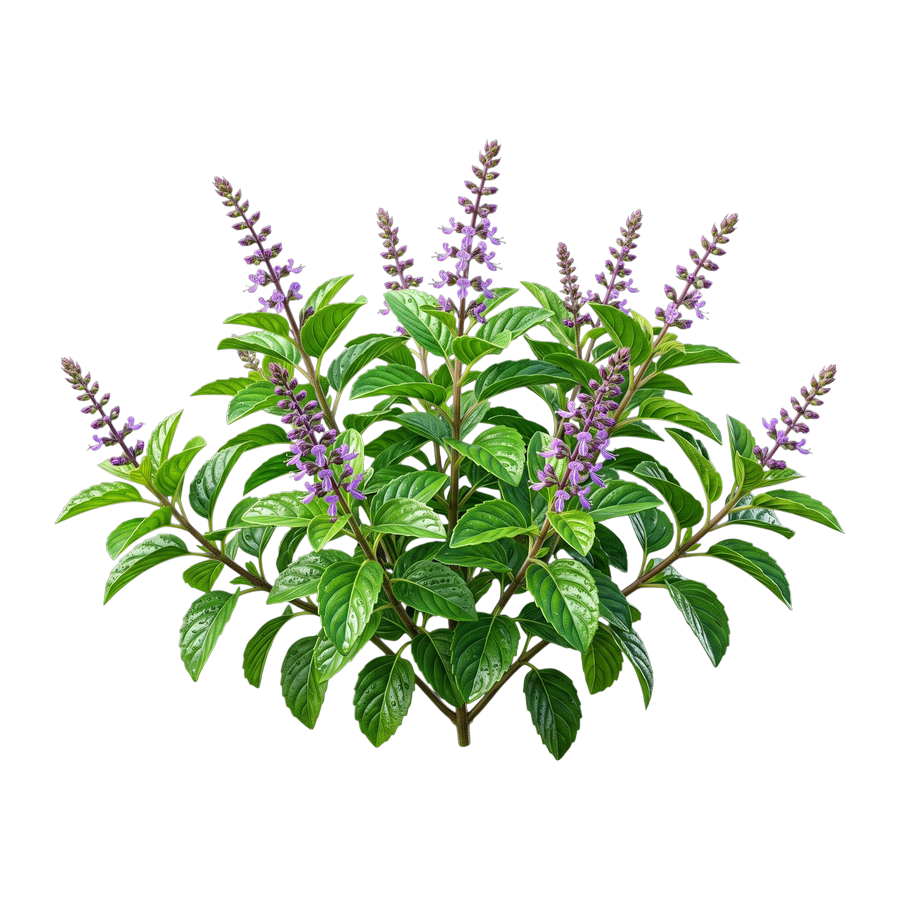
Ocimum tenuiflorum (syn. Ocimum sanctum) · also Ocimum gratissimum (Vana tulsi)
Food-first, education-only overview of Tulsi — the “Queen of Herbs” in Ayurvedic practice — covering plant types, aromatic chemistry, traditional uses, and what human research actually shows (with honest evidence strength).
Read this first. This page is orthomolecular / food-first literacy — botany, tradition, phytochemistry, and research context. It is not medical advice, not a cleanse, and not a claim that holy basil treats or cures disease. Essential oils and concentrated extracts are not casual kitchen tea. Pregnancy, fertility goals, anticoagulants, blood-sugar medicines, upcoming surgery, and thyroid conditions deserve clinician review before self-experimentation.
What holy basil is
Holy basil — Tulsi in Hindi, Tulasi in Sanskrit — is an aromatic shrub in the mint family (Lamiaceae). It is indigenous to the Indian subcontinent and now grown across the tropics. In Ayurveda it is called “The Incomparable One,” “Mother Medicine of Nature,” and “The Queen of Herbs,” and is treated as both a household sacred plant and a daily tonic herb.
Botanical naming: many papers still say Ocimum sanctum; modern taxonomy often prefers Ocimum tenuiflorum for the Rama/Krishna group. Culinary sweet basil (Ocimum basilicum) is a related kitchen herb — useful for pesto literacy — but it is not the same plant as Tulsi.
Journey2Health frames Tulsi the way we frame other food-first botanicals: start with tea and culinary amounts, read research with humility, and keep pharmaceuticals and diagnoses in clinician territory. See also the short Nature’s Detox entry on Tulsi and the Herbs library.
Rama, Krishna, and Vana types
Three named Tulsi traditions appear repeatedly in reviews:
Rama (Sri) tulsi — green-leaved O. tenuiflorum / O. sanctum cultivar.
Krishna (Shyama) tulsi — purplish-leaved cultivar of the same species complex; higher visual anthocyanin character.
Vana (wild/forest) tulsi — usually Ocimum gratissimum, a distinct species traditionally used in similar ways.
Chemotypes vary with cultivar, climate, and harvest. Eugenol content is often discussed as a shared aromatic signature across types, but exact secondary-metabolite profiles are not interchangeable “standard doses.” Product labels that only say “holy basil” without species/cultivar leave you guessing.
Traditional Ayurvedic uses
Classical and folk uses summarized in modern reviews include respiratory comfort (cough, cold folklore), digestive support, feverish states, skin and wound folklore, oral care (leaf/mouthwash traditions), and adaptogen-style daily tonic use for stress of living. Rituals of growing and offering Tulsi connect spiritual practice with daily plant contact — lifestyle context, not a lab endpoint.
Indian Materia Medica and Ayurvedic pharmacopoeia entries describe leaf preparations for bronchitis-type complaints, rheumatic folklore, and pyrexia traditions. Tea infusions and fresh-leaf use dominate household practice; essential oil is a different intensity class.
Active compounds (educational map)
Leaf chemistry is complex and chemotype-dependent. Compounds that appear repeatedly in phytochemical and pharmacology reviews include:
Eugenol — major phenolic essential-oil constituent; COX-related anti-inflammatory laboratory activity has been reported among Ocimum phenolics (e.g., Kelm et al., Phytomedicine, 2000 — summarized in nutrition-reporter digests hosted on DoctorYourself).
Ursolic acid and related triterpenoids — research-interest molecules in many Lamiaceae.
Rosmarinic acid and other phenylpropanoids / phenolics.
Mono- and sesquiterpenes such as β-caryophyllene, linalool, 1,8-cineole, ocimene, germacrene (profiles vary).
Naming a compound is not the same as proving a clinical effect at tea dose. Food-first literacy keeps the leaf tea and the concentrated extract on different shelves.
What research suggests (honest strength)
Narrative review (Cohen 2014). Marc Cohen’s open-access review in the Journal of Ayurveda and Integrative Medicine frames Tulsi as an adaptogen-leaning herb with preclinical and emerging clinical signals across physical, chemical, metabolic, and psychological stress themes, plus antimicrobial and oral-care folklore. Read it as a map of research directions — not as proof of every traditional claim.
Human systematic review (Jamshidi & Cohen 2017). This Evidence-Based Complementary and Alternative Medicine review located 24 independent clinical studies (about 1,111 participants, typically 2–13 weeks) on ingested Tulsi as a single herb. Domains clustered around metabolic measures (glucose, lipids, blood pressure), immunity, and neurocognition/mood. Authors reported generally favourable outcomes and sparse adverse-event reporting (one trial noted mild occasional nausea). Quality was mixed: many trials were small, short, or low Jadad score; only a minority were high-quality placebo-controlled designs. The authors explicitly called for larger, longer, better-standardized trials.
Practical reading for this site:
Stress / mood / cognition — several human studies report reductions in stress-related symptoms or improvements on selected cognitive tasks; evidence is promising but not definitive for any single standardized product. Cross-link: Anxiety attacks literacy (foundations first: magnesium, niacin, vitamin C, B-complex).
Blood sugar / metabolic markers — multiple small Indian clinical reports describe improvements in fasting/postprandial glucose or lipids; adjunct-to-medication trials exist. This is not permission to alter diabetes drugs. See Diabetes.
Immune / oral / antimicrobial angles — preclinical antimicrobial breadth is often cited; human immune-marker and respiratory folklore studies exist but are limited. Cross-link: Immune response, Immune bulletproofing, zinc, vitamin D, selenium.
Inflammation — laboratory COX/antioxidant findings support mechanistic interest; clinical anti-inflammatory endpoints in large modern RCTs are not the strength of the literature.
Evidence humility
Social graphics that quantify “+60% detox enzymes” or similar are marketing language — not endpoints verified in the reviews above. Prefer primary papers and systematic reviews over infographics.
Nutrition notes
Tulsi is used primarily for aromatic phytochemicals (tea, fresh leaf, powder, extract), not as a macronutrient staple. USDA FoodData Central has robust entries for culinary basil (e.g., fresh basil leaves) — useful for kitchen vitamin K / carotenoid / mineral ballpark literacy — but holy basil is not always listed as a separate FDC commodity. Do not swap pesto-basil nutrient tables one-for-one onto Krishna tulsi capsules.
Food-first pattern: grow or buy clean leaf, brew as tea, pair with the rest of an anti-inflammatory kitchen (turmeric, ginger, colorful plants) rather than chasing megadose extracts first.
How people use it (traditional / study-range literacy)
Common forms: fresh leaf tea or chew, dried leaf infusion, leaf powder in food or capsules, ethanolic extracts, and commercial standardized products. Essential oil and high-eugenol concentrates are a different risk class than a household cup of tea.
Across the 2017 systematic review, studied oral amounts varied widely — for example leaf aqueous extracts roughly in the hundreds of milligrams to a few grams per day, whole-plant aqueous extracts in multi-gram ranges, fresh-leaf preparations, and occasional tincture drop regimens, usually for weeks rather than years. Those figures describe what trials tried, not a Journey2Health dosing prescription.
Tea (household): a small handful of fresh leaves or 1–2 tsp dried leaf steeped — traditional daily tonic pattern.
Powder / capsules: follow labeled traditional amounts; prefer products that name species/cultivar.
Extracts: study products are not interchangeable; clinician review if you take metabolic or anticoagulant medicines.
Cautions & interactions
Pregnancy / fertility: traditional cautions and animal data raise fertility/reproductive questions at concentrated doses — avoid self-directed high-dose use in pregnancy; discuss with obstetric care.
Blood sugar medicines: additive hypoglycemia risk is a theoretical/clinical concern when combining with antidiabetic drugs — monitor with a clinician (diabetes page).
Anticoagulants / bleeding risk: eugenol-rich oils and some herb–drug interaction references advise caution before surgery or with anticoagulant regimens.
Surgery: stop concentrated products ahead of elective procedures on clinician timelines.
Thyroid note: animal and traditional discussions sometimes mention thyroid axis effects — people with thyroid disease should not self-adjust thyroid medication based on Tulsi essays.
Essential oil: not for undiluted internal experimentation; keep away from children as a “more is better” tonic.
The site’s standing medical disclaimer applies on every page: education only; no doctor–patient relationship; individual needs vary.
DoctorYourself — orthomolecular essays; holy basil appears in Nutrition Reporter digests (e.g., phenolic/COX notes) rather than as a dedicated Tulsi monograph
PubMed and orthomolecular links are starting points for self-education. Always read primary papers in full context and consult professionals for personal decisions. Traditional use and small clinical trials are not the same as large modern controlled-trial proof for every claim.