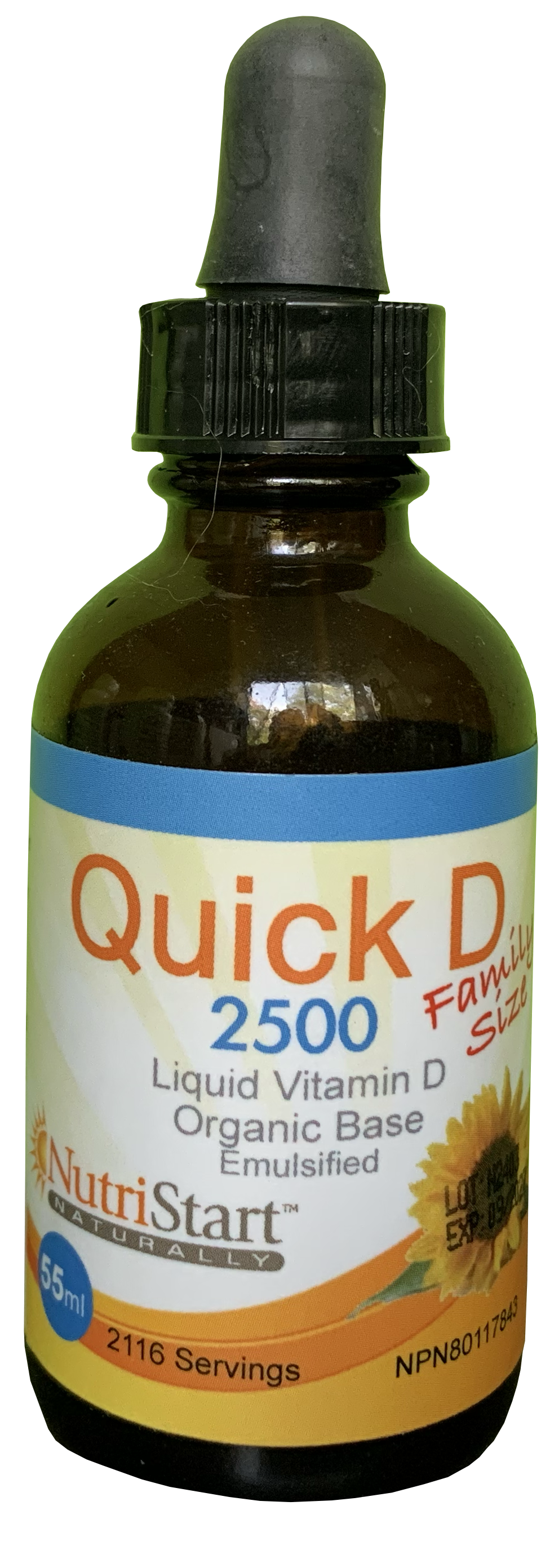
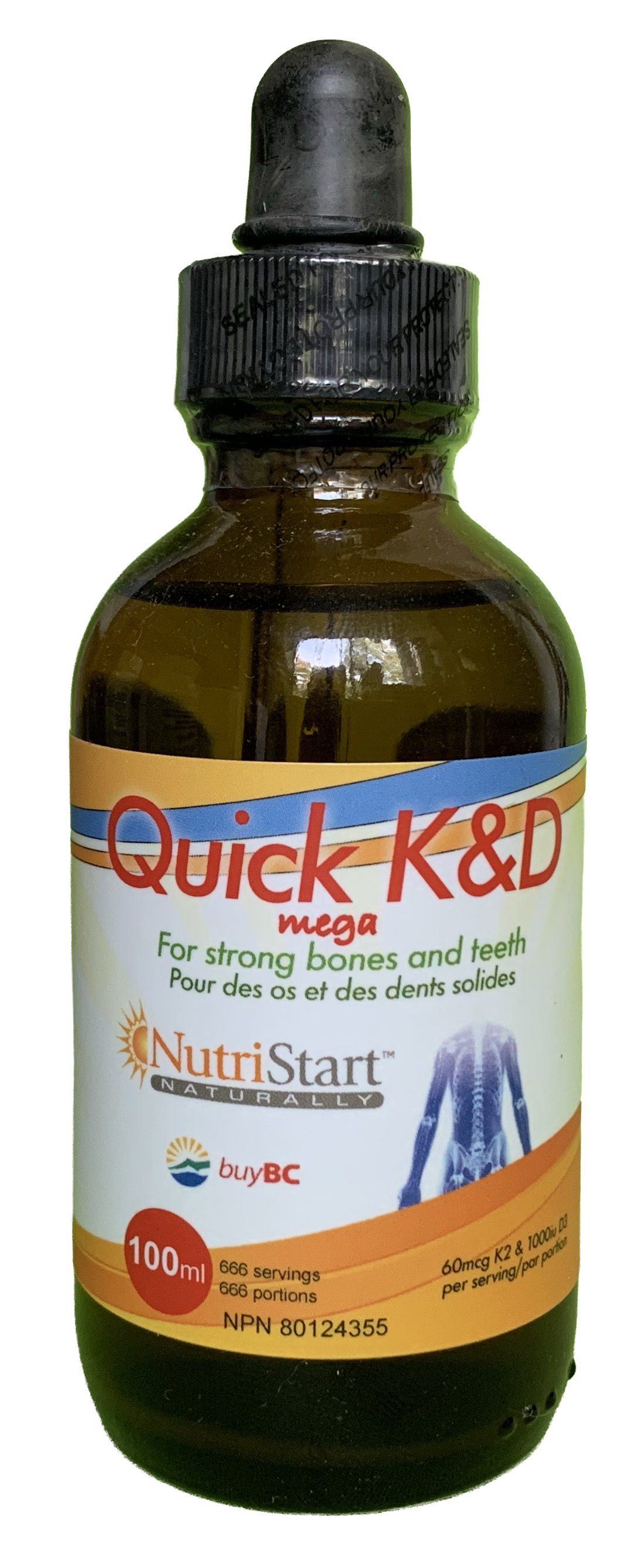
Deep educational overview of cholecalciferol physiology — not a dosing prescription. Shelf examples below include NutriStart Quick D 2500 and NutriStart Quick K&D.
Vitamin D3 is cholecalciferol — a fat-soluble secosteroid (cholesterol-like) molecule, often summarized as formula C27H44O. Orthomolecular and mainstream sources alike treat it as a prohormone: biologically inert until it is hydroxylated, then capable of hormone-receptor signaling across many tissues. See the Orthomolecular nutrient overview Vitamin D — calciferol and Andrew Saul’s DoctorYourself essay Vitamin D: Deficiency, Diversity and Dosage.
In animals (including humans), the skin precursor is 7-dehydrocholesterol. In food and supplements you will see “vitamin D3 (cholecalciferol)” from fish-liver oils or from lanolin-derived (wool-oil) cholecalciferol after UV processing — Saul notes the latter is often labeled as vegetarian but not vegan. Fish cannot synthesize vitamin D themselves; they accumulate it through the food chain. Cod-liver oil remains a classic concentrated food-oil source in historical nutrition education.
Educational takeaway: “vitamin D” on a label is not one identical molecule. Knowing whether a product is D3 or D2, and whether it is oil-based or dry, matters for literacy — even before anyone discusses IU numbers.
D2 vs D3 — careful distinctions
Vitamin D2 (ergocalciferol) is made from ergosterol (a fungal membrane sterol), not from cholesterol. Plants/fungi pathways and UV-irradiated yeast yield D2; animal skin and most modern supplemental “D3” bottles yield cholecalciferol. Chemically they differ by a side-chain carbon; metabolically both can raise serum 25-hydroxyvitamin D, but most evidence indicates D3 raises and maintains 25(OH)D more efficiently than D2 in humans (NIH ODS synthesis; Trang/Vieth-era comparisons cited in Saul’s essay).
D3 — human/animal pathway; preferred in many clinical and orthomolecular supplementation discussions.
D2 — fungal/yeast pathway; historically common in some fortified milks and older U.S. supplements; the form produced when mushrooms’ ergosterol is UV-converted (see food section).
Both undergo liver then kidney (and extra-renal) hydroxylation toward active hormone; neither is “fake vitamin D,” but they are not nutritionally identical in every study.
When this site’s shelf examples say Quick D / Quick K&D, they illustrate D3 products. UV-exposed mushrooms contribute mainly D2 — still useful dietary vitamin D literacy, especially for plant-forward eaters, without pretending D2 equals D3 milligram-for-milligram in every outcome study.
Skin synthesis under UVB
UVB radiation (roughly 290–320 nm) striking uncovered skin converts cutaneous 7-dehydrocholesterol to previtamin D3, which then isomerizes to vitamin D3. Season, latitude, time of day, cloud cover, smog, window glass (UVB does not usefully penetrate ordinary glass), melanin content, age, and sunscreen practice all change how much D3 the skin can make. The NIH ODS fact sheet summarizes these constraints: Vitamin D — Health Professional.
Orthomolecular writers (Saul; OMNS vitamin D collections) emphasize that winter UVB at higher latitudes is often inadequate for cutaneous synthesis, that heavily pigmented skin can block a large fraction of UV reaching deeper layers, and that total-body sun exposure can theoretically supply the equivalent of very large oral intakes — a physiologic context figure, not a tanning prescription. Excessive sun does not produce vitamin D toxicity the way unsupervised megadose pills can; photoproducts and feedback limit cutaneous overproduction. Skin-cancer risk still argues for sensible, individual sun practice — oral D3 literacy is the nutritional equivalent when sun is limited.
Obesity education note (Saul / Wortsman et al. tradition): adipose tissue can sequester vitamin D, so oral D3 is often discussed as more bioavailable than cutaneously made D3 in people with high body fat — again literacy, not a one-size dose chart.
Activation: 25(OH)D and 1,25-dihydroxyvitamin D (calcitriol)
Dietary or skin-derived vitamin D is still inactive as a hormone. Two hydroxylations matter:
Liver — 25-hydroxylase produces 25-hydroxyvitamin D [25(OH)D] (calcidiol). This is the main circulating storage/status marker; half-life is on the order of weeks in textbook summaries.
Kidney (and many extra-renal tissues) — 1α-hydroxylase produces 1,25-dihydroxyvitamin D [1,25(OH)2D] (calcitriol), the active hormone. Circulating calcitriol is tightly regulated by parathyroid hormone (PTH), calcium, and phosphate; it is generally a poor status marker because levels can stay “normal” until deficiency is severe.
OMNS educational summaries stress that extra-renal conversion lets local tissues make calcitriol for autocrine/paracrine gene regulation — one reason vitamin D literacy extends far beyond “bones and milk.” See OMNS: Summary of Vitamin D Evidence-Based Health Benefits… and the nutrient page linked above.
Thomas Levy’s orthomolecular writing (OMNS contributing editor) places vitamin D3 inside a broader immune-support and redox-terrain stack — typically alongside vitamin C, magnesium, K2, zinc, and related nutrients — rather than as a solo “magic IU.” Example framing: Levy OMNS commentary listing D3 in baseline immune support and public education at tomlevymd.com. That is Levy’s systems view, not a self-treatment protocol.
VDR nuclear signaling
Calcitriol binds the vitamin D receptor (VDR), a nuclear receptor present in intestine, bone, immune cells, muscle, brain, heart, pancreas, skin, and many other tissues. Ligand-bound VDR partners with retinoid X receptor (RXR) and influences transcription of a large set of genes — orthomolecular educators sometimes cite “hundreds of genes” or “on the order of ~10% of the genome” language as a way to communicate breadth (exact percentages vary by dataset; treat as educational scale, not a trivia contest).
Classic teaching points from Holick-era and OMNS reviews: VDR signaling affects cell proliferation, differentiation, and apoptosis; immune cell behavior; and calcium-handling proteins in gut and bone. Genetic variation in VDR, vitamin D–binding protein, and hydroxylase enzymes helps explain why two people on the same IU can show different 25(OH)D responses — OMNS discusses this as part of “vitamin D resistance” / systems biology literacy: Why Vitamin D Fails to Rise in Many People (also mirrored on orthomolecular.org).
Calcium–phosphate homeostasis, bone & muscle
Calcitriol increases intestinal absorption of calcium (and helps regulate phosphate). Together with PTH and fibroblast growth factor signaling, it participates in bone remodeling crosstalk. Frank deficiency in children is the rickets story; in adults, osteomalacia (soft, poorly mineralized bone) and contributions to osteopenia/osteoporosis risk appear in both NIH and Saul/DoctorYourself summaries.
Gut — active transport of calcium depends heavily on vitamin D–inducible mechanisms; “just eat more calcium” without D context is incomplete literacy.
Bone — mineralization and remodeling; calcium + D co-supplementation trials are the usual evidence lane for fracture discussions — results are mixed by population and dose design.
Muscle — proximal muscle weakness is a classic teaching feature of severe deficiency; fall-risk conversations in older adults appear in both mainstream and orthomolecular literature, with trial results not uniform.
Teeth — historical nutrient pages also list dental integrity among D-supported mineral tissues.
Saul’s essay reviews fracture-reduction and bone-density studies and argues that government RDA-scale intakes are often too low when sunlight is limited — labeled here as orthomolecular opinion to weigh against NIH RDA/UL tables, not as a personal prescription.
Immune modulation — innate and adaptive (educational framing)
Immune cells express VDR and can locally activate 25(OH)D to calcitriol. Educational literature describes support for innate defenses (e.g., antimicrobial peptide pathways in barrier tissues) and modulation of adaptive responses (helping temper excessive inflammatory signaling in many models). OMNS reviews associate low 25(OH)D with higher susceptibility language around infections and autoimmunity — while carefully noting that association is not the same as “D cures autoimmune disease.”
Word carefully: deficiency impairs host defense resilience in physiologic models; whether supplemental megadoses change outcomes in already-replete people is a separate, contested research question. Orthomolecular clinicians and OMNS authors often argue for proactive D3 sufficiency as foundational immune terrain (Levy’s baseline stack includes D3). Mainstream evidence summaries are more cautious and setting-specific. Hold both statements without collapsing them into certainty claims.
VDR is present in brain regions involved in mood regulation. Observational links between low 25(OH)D and depressive symptoms appear repeatedly; latitude and winter light also track seasonal mood patterns for many people. OMNS pieces discuss neuroprotective and mental-health associations as part of extra-skeletal vitamin D literacy.
Educational label — not a psychiatric treatment claim
Low vitamin D and low winter light can co-travel with mood changes. That does not mean self-prescribing high-dose D3 replaces evaluation for clinical depression, bipolar illness, or suicidal crisis. NIH-linked trial summaries have generally not shown reliable antidepressant effects from supplementation alone in already-treated or mixed populations. Use labs and clinicians; use emergency resources if mood becomes unsafe.
Orthomolecular and integrative reviews discuss vitamin D in relation to blood-pressure regulation (renin–angiotensin system), vascular inflammation, endothelial function, and plaque-stability biology. Observational data often show higher CVD risk at low 25(OH)D; seasonal CVD peaks in winter are sometimes cited as ecological clues. See OMNS: Vitamin D and Cardiovascular Health.
Mainstream clinical-trial synthesis (NIH ODS) is more reserved: many large RCTs did not show clear primary prevention of heart attacks or strokes from routine supplementation, especially when participants were already sufficient or doses were modest. Orthomolecular authors argue many null RCTs were poorly designed for nutrients (wrong baseline status, wrong dose, wrong analysis). Learners should read both frames: mechanistic plausibility and observational signals on one side; mixed interventional proof on the other. This page does not claim vitamin D treats or prevents cardiovascular disease.
Magnesium as a cofactor
Enzymes in vitamin D metabolism — including steps toward activation and binding-protein dynamics — are magnesium-dependent in nutritional biochemistry teaching. OMNS “vitamin D resistance” literacy lists magnesium among essential teammates: without adequate Mg, “normal” 25(OH)D can still feel functionally incomplete. See the cofactor discussion in Why Vitamin D Fails to Rise… and this site’s Magnesium page.
Practical education: pairing D3 conversations with magnesium food sources or clinician-guided Mg forms is coherence thinking — not proof that every person must buy a combo product. Kidney disease changes magnesium safety; clinician guidance first.
Integrative education often pairs D3 with vitamin K2 (commonly MK-7) because vitamin-K–dependent proteins (such as osteocalcin and matrix Gla protein) participate in calcium traffic toward bone and away from soft-tissue misuse — a coherence story when someone is raising vitamin D–driven calcium absorption. This site’s shelf already illustrates that pairing with NutriStart Quick K&D (D3 + K2 MK-7) alongside plain Quick D.
Important cautions: anticoagulant users (e.g., warfarin) need clinician guidance before changing K intake. K2 pairing is an educational co-travel idea — not a requirement that every D3 user buy a combination bottle, and not a claim that K2 prevents arterial calcification in every trial.
Food choices — UV-exposed mushrooms & other dietary sources
Few foods are naturally rich in vitamin D. Orthomolecular nutrient pages and NIH ODS lists converge on a short list — then mushrooms become a special teaching case because UV light can transform their sterols into vitamin D.
Mushrooms exposed to sunlight or UV lamps
Mushroom cell membranes are rich in ergosterol (provitamin D2). When fresh or dried mushrooms are exposed to sunlight or to commercial UV lamps, ergosterol converts to previtamin D2 and then to vitamin D2 (ergocalciferol). Reviews in the peer-reviewed literature document that UV treatment can raise vitamin D2 from near-trace levels in dark-grown mushrooms to nutritionally meaningful amounts — often described as manyfold to orders-of-magnitude increases depending on species, UV wavelength/intensity, duration, moisture, and surface area. See NIH-indexed reviews such as A Review of Mushrooms as a Potential Source of Dietary Vitamin D and Holick et al. on mushroom photobiology/bioavailability (Photobiology of vitamin D in mushrooms…). NIH ODS notes that some retail mushrooms are UV-treated specifically to raise D2, and that UV-treated mushroom powder is an approved additive source of D2 in some food uses.
What increases: mainly vitamin D2 (and related photoisomers such as D4 in some species/conditions) — not primarily human-identical D3, though some research notes additional photoproducts in certain mushrooms (e.g., shiitake discussions in photobiology papers).
Kitchen literacy: briefly sun-exposing sliced culinary mushrooms (gills up when practical) on a bright day is a traditional food-hack discussed in nutrition education; commercial UV-treated packs are another route. Exact IU per serving varies widely — check labels when present.
NIH example magnitude: ODS food tables show UV-exposed white mushrooms far higher in vitamin D per serving than non-exposed portabella diced mushrooms (illustrative contrast, not a home-lab promise).
D2 vs supplemental D3: mushroom D2 can raise serum 25(OH)D2 and contribute to status; many clinicians still prefer D3 supplements when the goal is efficient, sustained 25(OH)D repletion. Food D2 and supplemental D3 are complementary literacy lanes, not rivals in a purity contest.
Other dietary sources
Fatty fish — salmon, trout, sardines, mackerel, tuna; among the best natural D3 food sources (amounts vary with wild/farmed and diet of the fish).
Fish liver oils — cod liver oil is historically concentrated (also supplies vitamin A — label literacy matters).
Egg yolks — modest D3; pasture/season context can change amounts.
Liver and some cheeses — smaller amounts; animal foods may also contain some 25(OH)D metabolites that punch above their parent-vitamin listing in emerging research.
Fortified foods — many milks, plant milks, cereals, and some juices/margarines carry added D2 or D3 (region-dependent rules). Saul notes fortification as public-health acknowledgment that natural diets often under-deliver D.
Butter / fortified dairy fats — minor contributors in some patterns.
Food vs supplemental D3: food-first literacy covers ordinary adequacy for some people with sun + fatty fish + UV mushrooms + fortified staples. Orthomolecular repletion discussions (thousands of IU, lab-guided) live in a different educational lane than “eat your salmon and sun-mushrooms.” Both lanes matter; grocery produce and oils are not identical to measured liquid D3 drops.
Quantified dietary examples (USDA SR28)
Household figures below are scaled from USDA SR28 (same underlying USDA dataset historically shown on nutritiondata.self.com). nutritiondata.self.com was unreachable at edit time (DNS/server failure); NDB numbers are cited so values can be re-checked on nutritiondata.self.com when available, or via USDA FoodData Central.
Cod liver oil — 1 tsp (4.5 g) (NDB 04589): vitamin D ~450 IU; vitamin A RAE ~1,350 µg. Educational example only — vitamin A load matters; not a casual “more is better” oil.
Milk, 2% with added vitamins A & D — 1 cup (244 g) (NDB 01079): vitamin D ~120 IU; calcium ~293 mg; vitamin B-12 ~1.3 µg; protein ~8 g.
Egg, whole, raw — 1 large (50 g) (NDB 01123): vitamin D ~41 IU; vitamin B-12 ~0.45 µg; selenium ~15 µg; protein ~6.3 g.
Atlantic salmon, wild, raw — 3 oz (85 g) (NDB 15076): vitamin B-12 ~2.7 µg; selenium ~31 µg; niacin ~6.7 mg; protein ~17 g. (Vitamin D values for salmon vary widely by wild/farmed and cut; confirm on nutritiondata.self.com / FDC for the exact item you use.)
Sun, food, and supplemental D3 — putting the lanes together
Three inputs feed the same activation pathway:
Sun — endogenous D3 when UVB, skin, and season cooperate.
Food — D3 from animals/oils; D2 from UV fungi/yeast; fortified foods mixed.
Supplements — usually D3 oil drops or capsules for predictable intake when sun/food are insufficient.
Shelf examples on this site: NutriStart Quick D 2500 (liquid D3) and NutriStart Quick K&D (D3 + K2 MK-7). They are educational bottle examples — not buying orders or universal dose instructions. Daily ranges documented on My Protocol are one person’s recorded example, not a target for every reader.
Status labs & interpretive literacy
Serum 25(OH)D is the standard status marker. Unit confusion is common: nmol/L vs ng/mL (1 ng/mL ≈ 2.5 nmol/L). NIH FNB educational cut-points for bone-centric adequacy differ from orthomolecular “optimal” ranges discussed in OMNS (often higher targets with lab monitoring). Assay methods vary; trends on the same lab matter more than single-number perfectionism.
OMNS authors discuss personalized dosing because genetics, body weight, inflammation, malabsorption, and cofactors change response curves. Periodic retesting — rather than forever escalating IU — is the safety-minded literacy pattern. Measuring calcium (and sometimes PTH, phosphate, magnesium) belongs in clinician-supervised high-intake contexts.
Safety notes & cautions
Hypervitaminosis D → hypercalcemia: thirst, polyuria, nausea, anorexia, confusion, kidney injury risk, soft-tissue calcification with prolonged excess. Toxicity is almost always from excessive supplements, not from sun.
Granulomatous disease & some lymphomas: extra-renal over-activation of vitamin D can dysregulate calcium — specialist oversight mandatory.
Primary hyperparathyroidism, kidney disease, digoxin / thiazides / calcium-channel blockers: Saul and clinical references urge physician supervision before extra D.
Unsupervised megadoses + extra calcium: OMNS safety essays include cautionary cases of extreme IU intakes with calcium leading to severe hypercalcemia and renal impairment — education against DIY extremes.
NIH adult UL of 4,000 IU/day is a general-population ceiling concept; orthomolecular writers (Vieth, Saul, OMNS) argue many adults tolerate higher supervised intakes — that debate is literacy, not permission to ignore labs.
Infants, pregnancy, complex meds: clinician guidance — not internet dosing contests.
Never stop prescribed medications because of something you read here. Never use vitamin D as a reason to delay emergency care.
Shelf examples
More than one product can illustrate vitamin D on the shelf. Educational examples only — not buying or dosing advice.
NutriStart
Quick D 2500
Liquid vitamin D3 drops — primary example on My Protocol.
PubMed, NIH, and orthomolecular links are starting points for self-education. Always read primary papers in full context and consult professionals for personal decisions. Observational associations and historical clinical perspectives are not the same as modern controlled-trial proof for every claim.
Safety note. This page is orthomolecular literacy — chemistry, activation pathways, immune and bone context, food sources (including UV-exposed mushrooms), cofactor conversations, and safety. It is not medical advice, not a personal IU target, and not a claim that vitamin D cures disease. High-dose repletion belongs in conversation with a qualified clinician, with labs (25(OH)D, calcium, and clinical context). Excess can raise calcium. Granulomatous disease, lymphoma, primary hyperparathyroidism, and some medications change the risk picture — specialist care first.