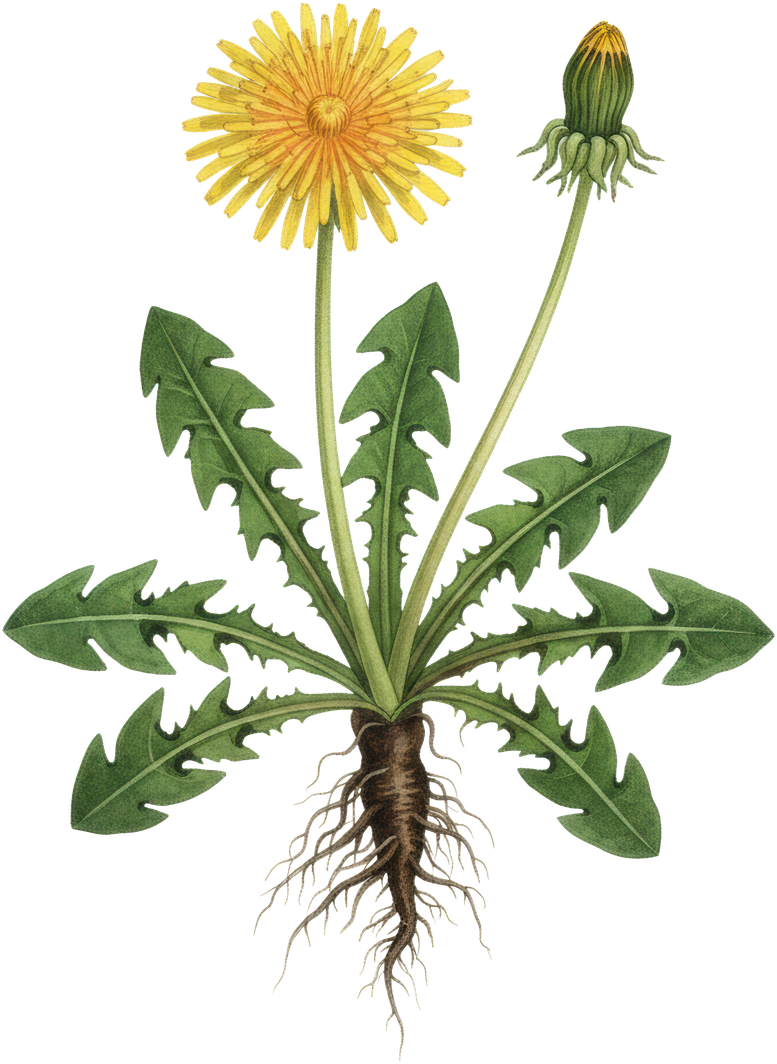
From Eurasian meadows to North American lawns — leaf, flower, and root as food, tea, roasted “coffee,” and traditional bitter medicine. Extensive educational literacy: origin, introduction history, Indigenous and settler kitchen uses, all edible parts, quantified nutrition, recipes, and orthomolecular caution labels.
Educational label — not a prescription. Culinary spices and kitchen herbs are discussed here as nutritional and traditional literacy — chemistry, history, quantified food composition, and orthomolecular/condition conversations found in Levy, OMNS, DoctorYourself, and related nutritional literature. This is not medical advice, not a claim that any spice cures disease, and not a reason to stop prescribed medicines. Essential oils are concentrated and are not the same as culinary pinches. Consult a qualified clinician before therapeutic use — especially if pregnant, on anticoagulants, have gallbladder/bile-duct issues, GERD, kidney disease, or allergies to related plants (e.g., Asteraceae for dandelion).
History — where dandelion originated
Old World / Eurasian context. Dandelion (Taraxacum officinale complex and related Taraxacum) is widely treated as native to Eurasia — meadows, paths, and disturbed soils of Europe and Asia. European herbal manuscripts, Chinese bitter-green and root traditions, and Greek/Arabic humoral herb writing all place the yellow composite flower and milky taproot in the food-and-medicine column long before turf culture called it a weed.
The English common name traces folk etymology to French dent-de-lion (“lion’s tooth”) for the jagged leaf. Medieval and early modern European herbals discuss leaf as spring bitter green, root as roasted beverage and bitter tonic, and latex folklore separately from modern clinical claims. Educational takeaway: dandelion’s “weed” identity is recent landscaping judgment layered on top of an older kitchen plant.
Introduction to North America
Historical botanical and ethnobotanical summaries commonly describe dandelion as introduced to North America by European colonists — intentional kitchen and medicine plantings and/or seed hitchhikers in forage, ballast, and garden soil. Once established, it naturalized aggressively in disturbed soils, pastures, and lawns across much of the continent.
Exact first-landing dates vary by region and source; genetics of local populations are not uniform. The educational arc is: Old World plant → colonial introduction → widespread naturalization → modern turf “pest” status. That arc does not imply dandelion was absent from every Indigenous plant vocabulary before contact in every place — it means the familiar lawn dandelion’s continental dominance tracks colonial disturbance ecology and European kitchen habits.
Today’s herbicide-lawn war is a twentieth-century aesthetic and chemical industry story. It does not erase leaf-as-green, root-as-beverage, or flower-as-seasonal folk food.
Traditional uses — Indigenous peoples & early settlers
Careful sourcing note
Indigenous North American plant knowledge is diverse across nations and regions. After introduction, many communities incorporated dandelion as an available food and medicine plant; that is not the same as claiming dandelion was a pre-contact pan-continental traditional species everywhere. Early settler uses are better documented in European-American herbals and homestead cookery. This section is historical education, not appropriation of any nation’s ceremonial knowledge. Prefer nation-specific ethnobotanical sources over viral pan-Indigenous lists.
Settler / Euro-American homestead kitchen
Spring greens — Young leaves cooked or in salad; bitterness rises with leaf age and heat.
Leaf and root teas — “Spring tonic,” bitter digestive, and folk diuretic language in herbals.
Roasted root “coffee” — Dried, roasted, ground root as a caffeine-free coffee alternative (European coffee-substitute culture carried into North American pantries; often blended with chicory).
Flowers — Petals in country wines, fritters, and dyes.
Medicine folklore — Bitter tonic and liver/bile folklore in Euro-American herbals — folklore mapping, not a license to self-treat liver disease.
Ethnobotanical compilations record food and decoction uses of naturalized dandelion among various Indigenous communities after the plant became locally abundant. Patterns often mirror practical wild-green and root-beverage use rather than a single continental doctrine. Always verify with nation-specific published sources; do not flatten hundreds of distinct knowledge systems into one “Native American dandelion cure” meme.
Educational takeaway: North America’s dandelion story is ecological naturalization plus kitchen practicality — leaf as green, root as beverage/bitter, flower as seasonal folk food — shared, adapted, and debated across settler and Indigenous foodways after introduction.
All edible parts
Leaf (greens)
Highest everyday food use. Young spring leaves are milder; mature summer leaves are sharply bitter. Pair with fat and acid (olive oil, lemon, vinegar) or briefly blanch. Dark-green micronutrient profile — notably vitamin K, vitamin A activity, vitamin C, calcium, iron, and potassium (see quantified section).
Root (fresh, dried, roasted)
Taproot carries bitter principles and inulin-type fructans. Fresh root can be sliced into stir-fries or broths in traditional practice; dried root for tea; roasted root for coffee-style brew. Roasting transforms flavor toward caramel/bitter-chocolate notes and is the classic homestead beverage method.
Flower (petals / whole blossom)
Seasonal fritters, syrups, and country wine. Many cooks remove the green base (receptacle) if it tastes too bitter. Petals add color and mild honey-like notes when separated carefully.
Crown / midrib
The pale crown where leaves meet root is cooked with greens in some traditional preparations; midribs can be stripped from very bitter mature leaves.
Latex: white sap is traditional topical folklore in some cultures — not a kitchen recipe on this page, and not a skin-disease protocol.
Traditional & nutritional “benefits” (education — no cure claims)
Bitter principles (sesquiterpene lactones) — traditional digestive / bile folklore; bitters as appetite and GI signaling literacy
Root inulin-type fiber — prebiotic carbohydrate interest when root is eaten; microbiome-feeding conversation in nutrition science
Mild diuretic folklore — fluid-balance stories in herbals; not a prescription diuretic and not a substitute for evaluating edema
Spring tonic tradition — seasonal bitter greens as food culture, not “detox magic”
Nature’s Detox on this site already flags marketing lines like “cleanses the liver twice as fast” as unverified. Keep dandelion in the food-herb column beside foundational orthomolecular nutrients — especially vitamin C depth and mineral literacy — not as a primary disease therapy.
No cure claims
Condition names and organ folklore appear only to map traditional and nutritional literature. Presence here is not evidence that dandelion treats hepatitis, gallbladder disease, kidney disease, or any other diagnosis.
Orthomolecular / nutritional uses in the body
In Journey2Health orthomolecular framing (Levy / OMNS / DoctorYourself literacy), dandelion is a bitter food-herb supporting kitchen diversity beside foundational nutrients. Levy-style oxidative-stress education does not crown dandelion as a primary electron-donor; that teaching centers ascorbate (vitamin C) and related redox terrain. Dandelion sits with culinary bitters and mineral greens — useful, quantified, traditionally respected, and carefully labeled.
Potassium-conscious greens — leaf as one food potassium source among many dark greens
Vitamin K food literacy — extremely high vitamin K density in leaf portions; relevant for people on warfarin who need consistent intake conversations with clinicians
Bitter signaling — educational GI/bile folklore without cholagogue bravado when stones or bile-duct obstruction may be present
Inulin root fiber — microbiome-feeding carbohydrate interest when root is eaten or roasted
Adjunct to — not replacement for — protocols — aromatic/bitter teas may appear beside magnesium comfort and hydration habits in kitchen practice; they do not replace clinician-guided care for named conditions on the Conditions library
Quantified nutrients (USDA-style)
Household figures below are scaled from USDA SR28 (same underlying USDA dataset historically shown on nutritiondata.self.com). NDB numbers are cited so values can be re-checked on nutritiondata.self.com when available, or via USDA FoodData Central.
Leaf (greens)
Dandelion greens, raw — 1 cup chopped (~55 g) (NDB 11207): vitamin K extremely high for the portion (~428 µg scaled); vitamin A RAE substantial (~280 µg); vitamin C ~19 mg; calcium ~103 mg; iron ~1.7 mg; potassium ~218 mg; magnesium ~20 mg (scaled from SR28 per-100 g × 55 g).
Dandelion greens, raw — per 100 g (NDB 11207): energy ~45 kcal; protein ~2.7 g; fiber ~3.5 g; calcium ~187 mg; iron ~3.1 mg; magnesium ~36 mg; potassium ~397 mg; vitamin C ~35 mg; vitamin A RAE ~508 µg; vitamin K ~778 µg — verify on FDC.
Cooked greens — volume shrinks; minerals concentrate per cup of cooked leaf — check FDC cooked entries when portioning boiled greens.
Root & roasted beverage
Fresh/dried root — USDA coverage is thinner and product-dependent; educational emphasis is inulin-type fiber and bitter flavor, not a multivitamin claim.
Roasted root “coffee” — composition varies with roast darkness and brew strength; treat as a flavor beverage first. Not a substitute for coffee’s pharmacology, and not a micronutrient multivitamin.
Flower
Petals are seasonal calorie-light folk food; do not expect leaf-level vitamin K density from fritters alone.
Kitchen recipes (culinary education)
1. Roasted dandelion root “coffee”
Dig or buy clean roots (herb suppliers sell dried medicinal-cut root if you are not foraging).
Scrub well; chop into small coins or matchsticks. Dry thoroughly (dehydrator or very low oven) until brittle.
Roast on a sheet pan at low-moderate heat, stirring, until fragrant and deep brown — not black charcoal.
Brew like coffee: ~1 tbsp grind per cup, French press or filter. Optional: blend 50/50 with roasted chicory root. Optional pinch of cinnamon.
Caffeine-free by nature; see also educational notes on caffeine if you are comparing habits.
2. Leaf tea
Steep 1 tsp dried leaf (or a small handful fresh young leaf) in hot water 5–10 minutes. Bitter. Traditional softener: lemon, or a sprig of mint / peppermint. Not a diuretic prescription.
3. Root tea (unroasted)
Simmer 1 tsp dried cut root in water 10–15 minutes. Earthier and more bitter than roasted “coffee.” Food-herb beverage only.
4. Sautéed greens
Wash leaves. Blanch older leaves 1–2 minutes to reduce bitterness; drain. Sauté in olive oil with garlic. Finish with lemon. Young spring leaves can go raw in salad with acid + fat + optional soft herbs.
5. Spring salad
Torn young dandelion leaves, thinly sliced red onion or radish, olive oil, lemon or vinegar, salt, pepper (black pepper). Optional toasted seeds. Keep portions modest if bitterness is new to your palate.
6. Flower fritters (seasonal)
Harvest open blossoms from clean sites. Optional: trim green base. Dip in a simple batter (flour + egg + water/milk + pinch salt) and pan-fry until golden. Educational folk recipe — not a nutrient protocol.
7. Petal accents
Pull yellow petals into salads or warm grain bowls for color. Avoid sprayed lawns.
Foraging & identification literacy
Harvest only from clean soils — no herbicide lawns, dog-run strips, roadside exhaust, or industrial runoff.
Learn lookalikes before eating any wild composite; when unsure, buy food-grade dried leaf/root from a reputable herb supplier.
One hollow flower stem per blossom and milky latex are classic field marks for common dandelion — still verify with a regional field guide.
Early spring leaf harvest is usually milder; hot-weather leaves are bitterer.
Mint & peppermint on this library list
Cooling aromatic mints sit beside bitter dandelion on the Spices educational shelf:
Peppermint — Mentha × piperita; tea vs oil distinction
Tea blenders often pair mint sweetness/coolness with dandelion bitterness — culinary harmony, not a medical formula. If mint worsens acid reflux for you, skip that pairing.
Health Resources 2026 working disk — Journey2Health educational compilation
Historical North American introduction framing draws on standard botanical naturalization narratives; nation-specific Indigenous uses require local ethnobotanical sources. Balanced education — not viral cure claims.