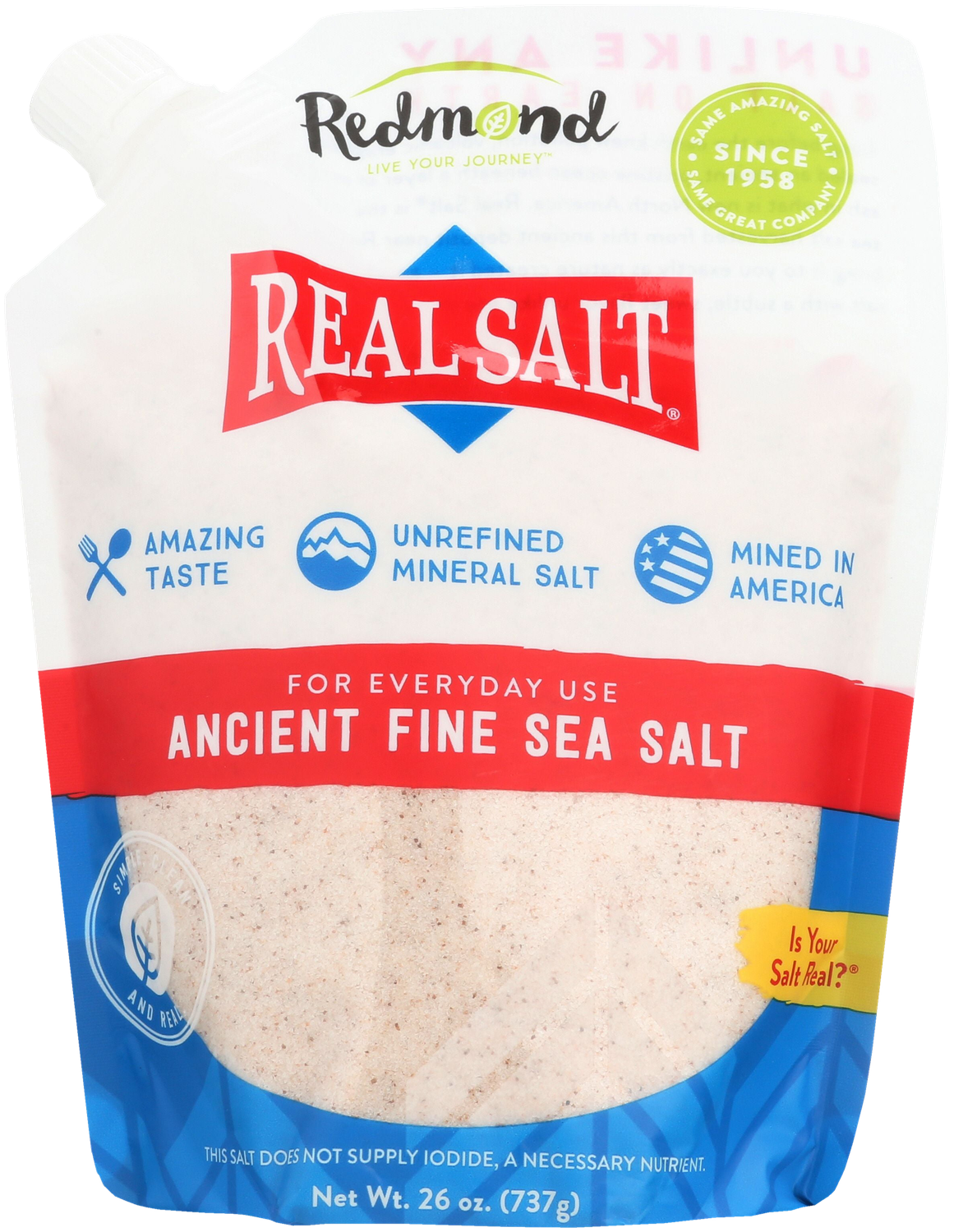
PRIORITY — Full mineral / trace spectra (published analyses)
Compiled from Redmond published mineral-analysis pages, third-party elemental sheets (e.g. 2025 trace mineral analysis PDFs circulating with Real Salt), and guaranteed-analysis tags for Redmond natural salt products. Different documents report different samples — treat figures as representative published literacy, then check the current COA for your bag.
Redmond Real Salt / Redmond salt published mineral literacy (lot-variable)
| Mineral / analyte | Published figures (representative) | Notes |
|---|
| Sodium chloride (NaCl) | ≈93–96% (guaranteed analysis band on some tags) | Major fraction — still a salt |
| Sodium (elemental) | ~354,100–387,700 ppm (~35–39%) in elemental analyses | Sample-dependent |
| Chloride | ~61% of weight in brand bioavailability discussion (with ~38% Na) | Brand education article |
| Calcium (Ca) | 0.35–0.85% on guaranteed tags; also listed in trace sheets | Macro mineral |
| Magnesium (Mg) | 0.06–0.09% on tags; elemental sheets ~486–922 ppm examples | Lower Mg than Celtic Light Grey typical PPM |
| Potassium (K) | ~0.03% on some tags | Modest |
| Sulfur (S) | ~0.07–0.2% | Tag |
| Phosphorus (P) | ~0.02% | Tag |
| Iron (Fe) | ~300–584 ppm (examples 308, 500, 584) | Visible pink/gray mineral character |
| Iodine (I) | ~10–12 ppm on some guaranteed tags | Still not equal to iodized salt strategy for everyone |
| Manganese (Mn) | ~5 ppm (tag) | Trace |
| Zinc (Zn) | ~3 ppm (tag) | Trace |
| Copper (Cu) | ~3 ppm (tag) | Trace |
| Selenium (Se) | Examples <0.5–2.26 ppm across sheets | Lot-variable |
| Silicon (Si) | ~594–3,000 ppm examples | Often high in unrefined inland salts |
| Boron (B) | ~1–4 ppm examples | Trace |
| Lithium (Li) | ~0.7–0.9 ppm examples | Trace |
| Strontium (Sr) | ~12–17 ppm examples | Trace |
| Chromium (Cr) | ~0.16 ppm example | Trace |
| Molybdenum (Mo) | ~0.08–0.57 ppm examples | Trace |
| Cobalt (Co) | ~0.08 ppm example | Trace |
| Vanadium (V) | ~0.18 ppm example | Trace |
| Fluoride | ~13.8 ppm example | Trace halogen |
| Bromine | ~10.5 ppm example | Trace halogen |
| Aluminum (Al) | ~215–725 ppm examples | Mineral matrix; not a supplement target |
| Lead (Pb) | ~0.06–0.25 ppm examples | Monitor via COA |
| Arsenic (As) | ~0.05–0.084 ppm examples | Monitor via COA |
| Cadmium (Cd) | ~0.017–0.27 ppm examples | Monitor via COA |
| Mercury (Hg) | Often <0.05 ppm / low | Monitor via COA |
Also reported among 50–60+ natural detections (alphabetical excerpts from published sheets): Aluminum, antimony, barium, bismuth, boron, bromine, cadmium, carbon, cerium, cesium, chromium, cobalt, dysprosium, erbium, fluoride, gadolinium, gallium, germanium, indium, iron, lanthanum, lead, lithium, lutetium, magnesium, manganese, mercury, molybdenum, nickel, niobium, phosphorus, potassium, praseodymium, rubidium, ruthenium, samarium, scandium, selenium, silicon, silver, sodium, strontium, tantalum, tellurium, thallium, thorium, thulium, tin, titanium, tungsten, vanadium, ytterbium, yttrium, zinc, zirconium (and related detections on sheets).
Compared with Celtic Sea Salt: Redmond analyses often show lower magnesium PPM than Celtic Light Grey’s 2026 Mg ranges, with distinctive iron/silicon inland-deposit character and Utah geology story. Neither replaces a magnesium supplement protocol when Mg repletion is the goal.
Units reminder
1 ppm ≈ 1 mg per kg of salt. A 1 g pinch at 500 ppm iron supplies ~0.5 mg iron — interesting, not an anemia protocol (see iron).
History & source (Redmond, Utah)
Redmond Real Salt is mined from an ancient seabed mineral deposit near Redmond, Utah (USA) — protected underground rather than evaporated from modern oceans. Brand narrative emphasizes unrefined crushing/screening without bleaching or anti-caking additive packages typical of refined table salt.
OMRI listing appears in brand materials for organic-production eligibility of Real Salt — process/cert literacy, not a medical claim.
Orthomolecular uses
Kitchen orthomolecular literacy (Saul / DoctorYourself tradition and OMNS pragmatist primers) often favors unrefined salts for everyday seasoning while centering therapeutic minerals — magnesium, potassium foods, vitamin C — as separate tools. Levy-style writing focuses more on oxidative stress and ascorbate than on gourmet salt brands; salt remains electrolyte context.
- Cook with Real Salt to taste on whole-food meals.
- Do not expect 60 trace minerals in a pinch to replace a varied diet or targeted repletion.
- If leaving iodized salt, plan iodine.
Bioavailability humility
Redmond’s own education notes that elemental analyses show which elements are present, not the chemical form or proven bioavailability of each trace. Orthomolecular honesty agrees: presence ≠ clinical dose.
Electrolyte network with magnesium & potassium
Redmond’s published magnesium figures (tag percentages ~0.06–0.09%, elemental sheets hundreds of ppm) are real but typically lower than Celtic Light Grey’s 2026 Mg PPM ranges. Potassium on some Redmond tags (~0.03%) is likewise modest. Educational comparison is not a brand war — it is spectrum literacy so readers do not assume every “natural salt” is magnesium-rich.
Use Celtic Sea Salt, Redmond, and ConcenTrace as different tools: culinary crystals vs ionic drops. Targeted magnesium and potassium food strategies remain separate decisions.
Physiology depth — inland ancient seabed vs modern ocean salt
Modern ocean-evaporated salts reflect today’s seawater ratios plus clay/mineral inclusions from local marshes. Redmond’s deposit is an ancient seabed sequestered in Utah geology — composition reflects that paleo-environment (notably silicon/iron character in many sheets). Both are still NaCl-dominant.
From a physiology standpoint, the sodium load and the eater’s kidney/heart/BP status dominate outcomes. Trace-mineral marketing should never outrank serum sodium disorders, edema, or clinician sodium advice.
Orthomolecular kitchen practice: season cast-iron vegetables and meats with unrefined salt; rebuild magnesium and ascorbate deliberately; treat “60+ minerals” as a purity/minimal-processing story more than a micronutrient multivitamin.
Practical amounts & mineral yield math
- 1 g Real Salt at ~500 ppm Fe ≈ 0.5 mg iron; at ~12 ppm I ≈ 0.012 mg iodine; at ~600 ppm Mg ≈ 0.6 mg magnesium.
- Brand bioavailability note — Redmond states analyses show elements present, not proven absorption of each trace form.
- OMRI / organic process listing — production eligibility literacy, not a disease claim.
For food-sodium comparisons in recipes, use USDA FoodData Central; for Real Salt traces, prefer Redmond’s mineral-analysis hub and current COAs.
Kitchen protocol literacy (education)
A practical orthomolecular-style kitchen pattern many readers reconstruct from DoctorYourself-type teaching:
- Cook real food — vegetables, proteins, legumes — seasoned with unrefined salt to taste.
- Replete magnesium deliberately (food + supplemental forms when indicated).
- Keep vitamin C literacy active for collagen/redox education.
- Plan iodine if you abandon iodized salt.
- Compare spectra with Celtic Sea Salt rather than collecting every boutique salt on earth.
None of this treats Real Salt as a pharmaceutical. It treats salt as a daily food input with a measurable mineral matrix.
Side-by-side spectrum literacy vs Celtic
Educational comparison using published brand typical figures (lot-variable):
- Magnesium — Celtic Light Grey 2026 typical ~7,000–14,000 ppm vs Redmond tag ~0.06–0.09% (600–900 ppm order) or elemental sheets hundreds–low thousands ppm. Celtic usually wins Mg density literacy.
- Iron / silicon — Redmond sheets often show higher Fe/Si character from Utah deposit mineralogy.
- Iodine — Redmond tags sometimes list ~10–12 ppm; Celtic Fine Ground COA examples often <0.002%. Neither replaces a planned iodine strategy for everyone.
- Sodium dominance — both remain culinary salts; BP/CKD rules still apply (sodium & chloride).
Choose based on taste, COA transparency, and kitchen habit — not miracle claims. Keep magnesium repletion as its own decision.
Shelf notes
Education page — no invented AOR URL. Official analysis hub: living.redmond.com mineral-analysis. Not an affiliate endorsement.
Gram-scale reality check: even a generous 3 g sprinkle of Real Salt is still mostly sodium chloride. Trace lines on ICP sheets explain color and flavor mineralogy; they do not recreate a B-complex, magnesium glycinate serving, or varied plate of superfoods and complete-protein foods from the amino acids hub. Keep culinary salt in its lane.
References & further learning
Standing nutritional-literature disclaimer: this site’s educational material draws on orthomolecular and nutritional literature (including Levy, OMNS, DoctorYourself) alongside agency data (NIH ODS, USDA). It is not medical advice, diagnosis, or treatment. Always consult a qualified clinician for personal decisions.