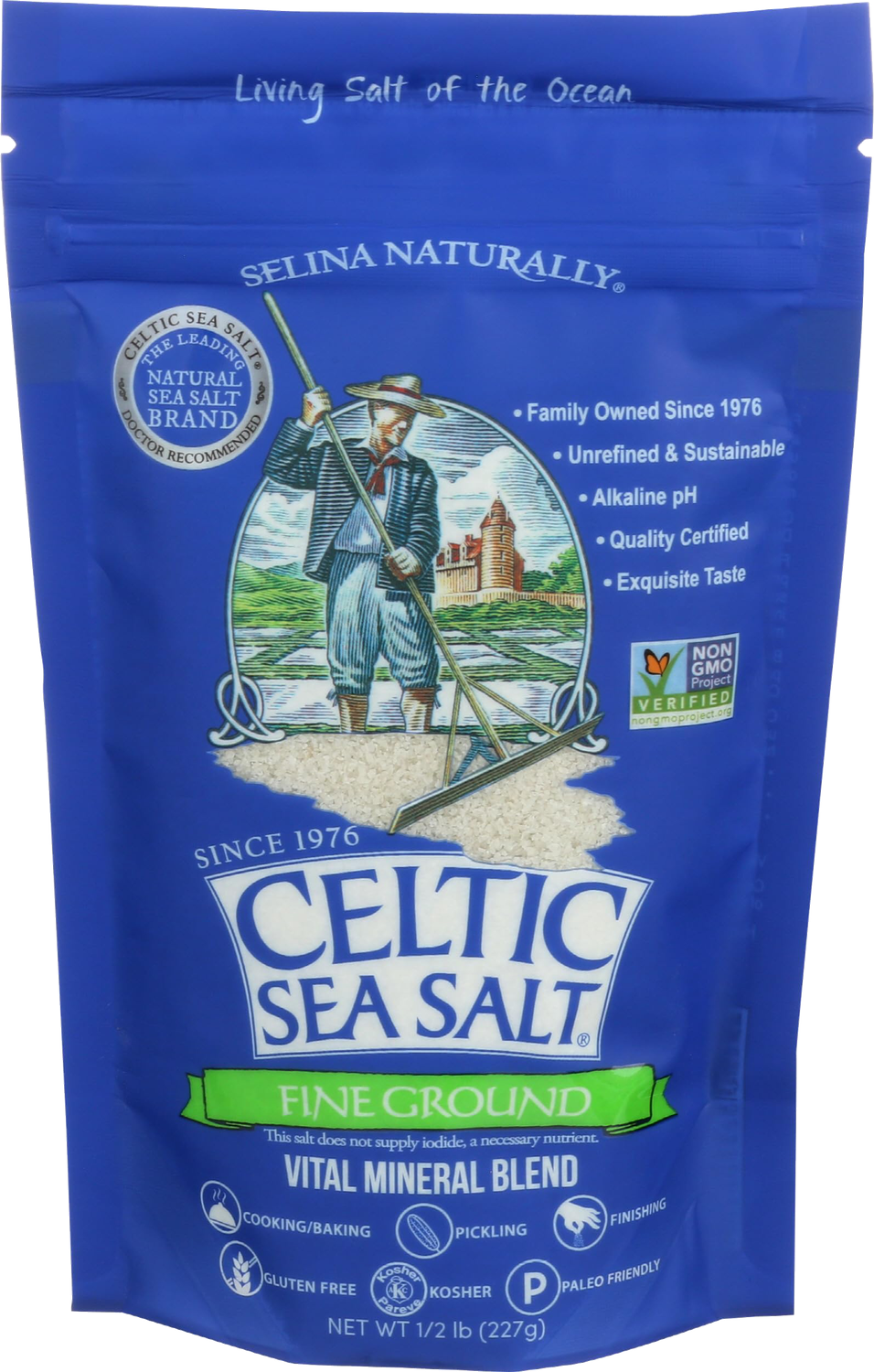
Read this first. Unrefined sea salt is still mostly
sodium chloride by weight. Trace minerals are real but usually
tiny versus dedicated
magnesium or
potassium foods/supplements. Celtic products are typically
not iodized at meaningful levels — pregnancy and thyroid planning still need an
iodine strategy. Standing nutritional-literature disclaimer: this site’s educational material draws on orthomolecular and nutritional literature (including Levy, OMNS, DoctorYourself) alongside agency data (NIH ODS, USDA). It is not medical advice, diagnosis, or treatment.
PRIORITY — Full mineral / trace spectra (published analyses)
Values below prioritize manufacturer-published, third-party lab typical ranges for 2026 Celtic Fine Ground™ and Light Grey Celtic® (mean ± 1 SD style ranges on the brand Quality & Safety / Minerals pages). Additional elements appear on lot Certificates of Analysis (COAs) and older spec sheets — always expect lot-to-lot natural variation. PPM = mg/kg ≈ µg/g of salt.
Celtic Sea Salt® published mineral literacy table (educational compilation — verify current COA for your lot)
| Mineral / analyte | Celtic Fine Ground™ | Light Grey Celtic® | Notes / source |
|---|
| Sodium (Na) | — | Fine Ground 32.5–35.2%; Light Grey 29.2–34.2% (w/w) | Celtic quality-safety 2026 typical ranges |
| Implied NaCl | — | Fine Ground ~82.6–89.4%; Light Grey ~74.4–86.9% | Derived from Na; pure NaCl reference 39.3% Na |
| Chloride (Cl) | — | Major anion with Na; retained with moisture/minerals | Brand mineral narrative + historic COAs |
| Magnesium (Mg) | 6,999–13,744 | 6,987–14,439 | PPM typical range, 2026 labs |
| Potassium (K) | 2,857–5,242 | 2,738–5,449 | PPM |
| Calcium (Ca) | 3,037–4,244 | 3,274–4,771 | PPM |
| Iron (Fe) | 9.6–13.6 | 10.1–16.2 | PPM |
| Manganese (Mn) | 2.1–3.0 | 1.0–6.8 | PPM |
| Zinc (Zn) | Trace / COA | Often < detection or low ppm on older COAs (e.g. <0.0013%) | Lot COAs; not always in routine PPM table |
| Copper (Cu) | Trace / COA | Older COA examples <0.0025% or ~1.9 ppm | Lot-variable |
| Iodine (I) | Trace / COA | Often <0.002% (~<20 ppm) on Fine Ground COA examples — not a substitute for iodized salt strategy | Critical literacy |
| Selenium (Se) | Trace | Listed among naturally occurring traces by brand; quantify on lot COA | COA |
| Boron (B) | Trace | Listed among traces; lot COA | COA |
| Chromium (Cr) | Trace / COA | Older COA examples <4 ppm | COA |
| Moisture | Variable | Light Grey traditionally higher residual moisture (sel gris character) | Harvest method |
| Lead (Pb) | Median ND | Light Grey median ~58.5 ppb (2026); Fine Ground median ND | Heavy-metal panel 2026 |
| Arsenic (As) | Median ND | Median ND both products (2026) | Heavy-metal panel |
| Cadmium (Cd) | Median ND | Median ND both products (2026) | Heavy-metal panel |
| Mercury (Hg) | Never detected | Never detected (2026 reported) | Heavy-metal panel |
Household scale example (educational math, not a supplement dose): 1 gram of Light Grey salt at ~10,000 ppm magnesium contains about 10 mg magnesium — helpful flavor mineral synergy, not a replacement for the intakes discussed on the magnesium page.
Historic Fine Ground-style COA snapshots (older published spec sheets) have also listed approximate major fractions such as chloride ~57.6%, sodium ~34.7%, NaCl ~92.3%, calcium ~0.213%, magnesium ~0.496%, potassium ~0.108%, iodine <0.002%, with copper/zinc often below listed percent thresholds — useful as order-of-magnitude literacy beside the 2026 PPM key-mineral table.
How to read this table
Major electrolytes (Na/Cl) dominate grams. Mg/K/Ca in the thousands of PPM are the meaningful ‘mineral signature’ differentiators versus refined salt. Fe/Mn are low double-digit PPM. Zn/Cu/I/Se/B and many other traces exist in seawater-derived salts but are often near detection limits — they do not turn a salt shaker into a multimineral.
History & source (Celtic / French marshes)
The trade name Celtic Sea Salt® traces to Jacques de Langre’s 1970s encounter with traditional French Atlantic salt farmers (Guérande / Brittany sel gris lineage) who harvested with sun, wind, and wooden tools rather than industrial refining. “Celtic” names a harvesting method and mineral-preservation ethos, not a claim that every bag is exclusively from one Celtic archaeological site.
Today the brand partners with artisan producers in France and other coasts (Guatemala, Hawaii, Spain, Portugal, and beyond per brand materials), emphasizing hand harvest, minimal processing, residual moisture in grey salts, and lot testing. Educational takeaway: source story + lab transparency matter more than romantic packaging.
Related on this site: sodium physiology, ConcenTrace ionic brine concentrates, and Redmond Real Salt (Utah inland ancient seabed).
Vs refined table salt
- Refined table salt — typically ~98–100% NaCl; anti-caking agents; often iodized (public-health win for iodine deficiency).
- Celtic-style unrefined salt — lower implied NaCl percentage because moisture + Mg/K/Ca/other minerals remain; flavor is rounder; usually not a reliable iodine vehicle.
- Color/moisture — Light Grey (sel gris) retains brine minerals and clay-mineral character; Fine Ground is drier/more free-flowing with its own PPM signature.
- Marketing humility — “84 minerals” talk is about detectable seawater elements, not 84 RDA-level doses per pinch.
Orthomolecular / DoctorYourself kitchen traditions often prefer unrefined salts for culinary mineral breadth while still treating iodized salt or separate iodine as a thyroid strategy when needed.
Orthomolecular uses & electrolyte literacy
Thomas Levy and related OMNS/oxidative-stress educators emphasize electrolyte and mineral terrain broadly — often alongside vitamin C, magnesium, and hydration — without treating gourmet salt as a cure. Educational uses learners discuss:
- Seasoning food to support voluntary vegetable/protein intake (adherence literacy).
- Homemade electrolyte drinks using unrefined salt + potassium-rich foods (citrus, coconut water patterns) — not for heart/kidney patients without clinician OK.
- Avoiding exclusive reliance on sodium-stripped diets that leave some people lightheaded — individual BP/kidney context dominates.
- Pairing salt literacy with magnesium repletion rather than expecting salt alone to fix Mg deficiency.
Educational label — not a prescription
Salt choice does not replace DASH-style patterns, BP medication, or CKD dietitian plans. Hypernatremia and fluid overload are medical issues.
Electrolyte network with magnesium & potassium
Human extracellular fluid is sodium-rich; intracellular fluid is potassium-rich. The Na⁺/K⁺-ATPase maintains that gradient using ATP — and magnesium is part of ATP’s biologically active Mg-ATP story on this site’s magnesium page. Unrefined salts that carry measurable magnesium and potassium alongside sodium are educationally interesting as culinary electrolyte ensembles, not as complete repletion tools.
Celtic Light Grey’s 2026 typical magnesium ranges (~7,000–14,000 ppm) mean a careful cook using several grams of salt across a day still obtains only tens of milligrams of magnesium — helpful synergy with leafy greens, seeds, and supplemental magnesium when indicated, but nowhere near replacing a documented magnesium protocol.
Potassium in Celtic salts (roughly 2,700–5,400 ppm typical) similarly cannot rival a potato, bean, yogurt, or salmon serving. Orthomolecular educators who praise unrefined salt almost always still push potassium-rich foods hard (see potassium).
Physiology depth — sodium & chloride beyond the shaker
Sodium is obligatory for extracellular fluid volume, nerve depolarization, and intestinal nutrient co-transport (e.g., glucose-sodium cotransport literacy). Chloride partners as the major extracellular anion and appears in gastric acid (HCl) teaching. Deficiency of total body sodium is usually a medical/hospital story (losses, adrenal, overhydration) rather than a “forgot the salt cellar” story in healthy people eating mixed diets.
Conversely, population sodium excess tracks with blood-pressure risk in many — not all — people. Orthomolecular nuance (and some clinicians) argue that mineral-poor, ultra-processed sodium differs from sodium taken with magnesium/potassium-rich whole meals. That hypothesis does not license unlimited pink or grey salt in heart failure. Hold both: food quality matters; disease-specific sodium limits still matter.
DoctorYourself / OMNS kitchen essays historically encouraged unrefined sea salts while remaining aggressive about vitamin C, magnesium, and nutrient density overall. Thomas Levy’s public teaching centers oxidative stress and ascorbate more than salt branding — use salt pages as electrolyte context beside vitamin C.
Practical amounts & mineral yield math
Educational yield table assuming mid-range published PPM (order-of-magnitude; lots vary):
- 1 g Light Grey Celtic at ~10,000 ppm Mg ≈ 10 mg magnesium; at ~4,000 ppm K ≈ 4 mg potassium; at ~4,000 ppm Ca ≈ 4 mg calcium; at ~12 ppm Fe ≈ 0.012 mg iron.
- 5 g/day culinary salt (about a teaspoon depending on crystal packing) ≈ ~50 mg Mg and ~20 mg K from those assumptions — still a fraction of common dietary targets, while sodium from 5 g of ~80–90% NaCl salt is roughly 1.5–2 g sodium territory (math depends on exact Na%).
- Iodine at <20 ppm means 5 g salt supplies <0.1 mg iodine — often far below intentional iodization strategies; do not drop iodized salt or seafood/dairy plans solely because salt is “sea-derived.”
USDA FoodData Central catalogs many salted foods but rarely replaces brand COAs for artisan salts — cite Celtic’s Quality & Safety pages and lot COAs as primary spectra sources, with FDC for general sodium food literacy.
Shelf notes
Education page — no invented AOR product URL (AOR is not the Celtic brand). Buy from reputable sellers; prefer lots with accessible COAs. This is not an affiliate pitch.
References & further learning
Standing nutritional-literature disclaimer: this site’s educational material draws on orthomolecular and nutritional literature (including Levy, OMNS, DoctorYourself) alongside agency data (NIH ODS, USDA). It is not medical advice, diagnosis, or treatment. Always consult a qualified clinician for personal decisions.