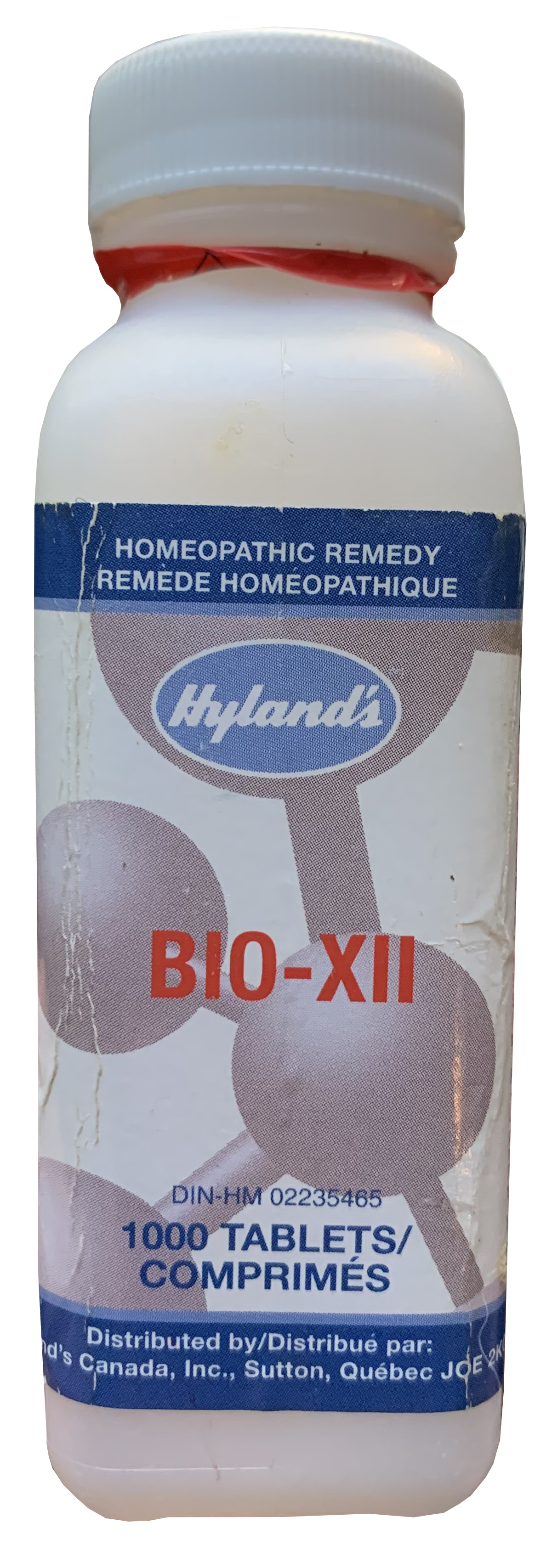
Manufacturer: Hyland's (Canada) · Product: Bio-XII (12 cell salts / Bioplasma complex). Education only — not a purchase recommendation.
Read this first. Schuessler cell salts are a complementary biochemic / homeopathic-adjacent tradition distinct from orthomolecular megavitamin or gram-dose mineral repletion. Traditional “deficiency signs” below are historical educational framing from tissue-salt literature — not modern disease diagnoses, not laboratory mineral-deficiency criteria, and not claims that BIO-XII treats, cures, or prevents disease. Persistent symptoms need proper clinical evaluation. Food-first and measured nutritional minerals remain the load-bearing walls on this site.
Cell salt theory — Schuessler “biochemistry” (educational history)
In the late nineteenth century, German physician and physiological chemist Wilhelm Heinrich Schuessler (also spelled Schüssler) proposed a cellular mineral model he called biochemistry — chemistry of living tissues. Building on contemporary cell theory (including Virchow’s emphasis on the cell as the seat of disease), Schuessler argued that inorganic mineral salts, though present in tiny absolute amounts relative to water and organic matter, were indispensable “workers” that help organize and rebuild the body’s constantly turning-over cells.
His educational logic, restated without modern marketing gloss, ran roughly like this:
Healthy cell metabolism depends on adequate cell nutrition — including inorganic mineral constituents.
If those inorganic “tissue salts” are out of balance at the cellular level, assimilation, excretion, and repair become disordered — and functional disturbance follows.
Supplying the missing salt in a highly diluted, readily absorbable (traditionally trituration / low-potency) form was proposed to restore cellular mineral signaling and metabolism.
Classic lists settle on twelve mineral salts (fluoride, phosphates, sulphates, chlorides, and silica) that Schuessler and later biochemic writers associated with specific tissues and symptom patterns. Later combination products — including Bioplasma / BIO-XII–style “all twelve” tablets — package that catalogue for convenience.
Educational label — tradition, not RCT equivalence
Schuessler biochemic theory is historical complementary literacy. It is not identical to modern clinical nutrition, serum mineral labs, or evidence standards used for frank deficiency (e.g., iron-deficiency anemia workups, magnesium repletion under kidney-aware care). Treat classic “indications” as cultural and historical teaching — useful for understanding why the twelve exist — not as a diagnostic algorithm or a substitute for medical care.
How BIO-XII fits as a combined twelve
Shelf example on Journey2Health: Hyland’s Bio-XII (formerly marketed in the Schuessler / Bioplasma “12-in-1 cell salts” lane). Combination twelve products grew after Schuessler’s era as a practical answer to a common learner question: Wouldn’t taking all twelve cover the bases? Traditional teachers often still preferred symptom-matched singles; combinations were framed as a general “cellular tonic” or recovery-support pattern when someone did not want to choose one salt.
Educational posture on this site:
BIO-XII = one bottle containing the classic twelve tissue salts together (low-dose / homeopathic-adjacent preparation style — check the actual label for potencies and lactose/excipient notes).
It is a product exception already on the Journey2Health shelf — not an AOR blend, and not a claim that this complex equals dietary mineral repletion.
Think of it as optional traditional furniture in the mineral room: interesting complementary history beside the load-bearing nutrient pages (C, D, magnesium, zinc, B’s…).
Manufacturer education and retail pages describe Bio-XII as a twelve cell-salt / Bioplasma-style complex. This site links those pages as shelf examples only — not purchase pressure and not a “best brand” verdict.
Nutrition vs low-dose tissue salts — keep the lanes separate
Two different educational worlds share mineral names and should not be collapsed:
Nutritional / orthomolecular minerals — milligram-to-gram intakes from food and supplements intended to fill body pools (bone magnesium, hemoglobin iron, dietary sodium/potassium, etc.). Pages such as Magnesium, Zinc, and Vitamin C live here. Thomas Levy, OMNS, and DoctorYourself writing usually operate in this lane when they discuss mineral repletion, oxidative stress, and electrolyte terrain.
Schuessler tissue / cell salts — traditionally prepared at low homeopathic potencies (often 6X in classic biochemic retail), with microgram-or-less material mineral content per tablet in many preparations. The tradition emphasizes mucosal absorption and “cellular signaling / assimilation bridging,” not matching RDA mineral math.
Practical literacy: a BIO-XII tablet is not a substitute for spinach magnesium, pumpkin-seed zinc, or a clinician-guided iron protocol. Conversely, eating mineral-rich food does not automatically teach you Schuessler’s historical symptom language. Hold both lanes without pretending they are the same dose, the same evidence base, or the same clinical tool.
Where this page notes “orthomolecular crossover,” it means: the same elemental family (Mg, Fe, Ca, K, Na, Si…) appears in Levy / OMNS / DoctorYourself nutritional literature — useful for deeper mineral physiology — while still labeling Schuessler indications as traditional biochemic framing.
1. Calcarea fluorica (Calcium fluoride)
Physiological / biochemical role (elemental family): Fluoride appears in nature as calcium fluoride (fluorspar) and, in tiny amounts, in mineralized tissues. In mainstream dentistry and bone biology, fluoride’s educational story centers on enamel crystal chemistry and skeletal mineralization — distinct from municipal water-fluoridation policy debates. Biochemic tradition specifically names calcium fluoride as the salt of elastic fibres and hard surface tissues.
Systems traditionally emphasized: tooth enamel surface, periosteum / bone surface tone, elastic fibres of skin and vessel walls, ligaments and connective elasticity.
Traditional biochemic imbalance signs (historical education — not diagnoses): classic Schuessler and later tissue-salt handbooks associate Calc. fluor. with loss of elasticity — relaxed or dilated vessel walls (varicose-vein language), hemorrhoidal congestion patterns, cracked or fissured skin, enamel quality concerns, stretched ligaments, and “dragging” connective symptoms. Always labeled here as traditional symptom folklore.
Homeopathic / biochemic context: In Boericke/Dewey-style teaching, Calcarea fluorica is linked to relaxation of elastic fibre and malnutrition of bone surfaces/teeth. Schuessler-era manuals treat it as the elasticity salt. Do not confuse calcium fluoride (the traditional tissue salt) with sodium fluoride used in water fluoridation — different compounds, different educational conversations.
Orthomolecular crossover: Modern OMNS bone-health writing (including Levy-adjacent calcium caution) stresses that calcium is not a solo hero — magnesium, vitamin K, vitamin D status, and soft-tissue calcification risk matter more than blindly stacking calcium. Calc. fluor. tissue-salt tradition is not a calcium-supplement megadose; if you are studying bone minerals seriously, pair this subsection with Magnesium, Vitamin D, and OMNS bone essays rather than treating 6X Calc. fluor. as dietary calcium repletion.
2. Calcarea phosphorica (Calcium phosphate)
Physiological / biochemical role: Calcium phosphate minerals (hydroxyapatite family) are the dominant inorganic phase of bone and teeth. Phosphate is also central to ATP, nucleic acids, membrane phospholipids, and cellular buffering. Nutritional science treats calcium and phosphorus together for skeletal mineralization; JOM-era mineral-interrelationship essays note Ca–Mg–P synergy in osseous tissue.
Systems traditionally emphasized: bone and teeth formation, growth and convalescence, connective/cellular “building,” digestion/assimilation narratives in biochemic texts, blood corpuscle support language in classic manuals.
Traditional biochemic imbalance signs: Schuessler literature calls Calc. phos. a primary cell-builder — delayed bone formation language in the young, slow knitting narratives after fracture (historical), poor convalescence, “weak constitution,” growing-pain folklore, and general undernourished / anemic-pattern teaching in older biochemic books. These are traditional pattern associations, not pediatric or orthopedic treatment orders.
Homeopathic / biochemic context: Often nicknamed a constitutional or “cell-wall” salt in popular tissue-salt teaching; Dewey’s materia medica notes restorative use after acute disease and callus-formation educational indications. Combination twelve products lean on Calc. phos. as a core “growth / rebuild” member of the set.
Orthomolecular crossover: Food calcium (dairy, fortified foods, leafy greens with absorbable patterns) and phosphate balance belong to nutrition math. Levy / Cheng OMNS bone commentary warns that isolated calcium supplementation can be problematic in adults when magnesium and K2 contexts are ignored. Study dietary Ca/P with labs and clinician guidance; do not equate BIO-XII Calc. phos. content with correcting hypocalcemia or osteoporosis protocols.
3. Calcarea sulphurica (Calcium sulphate)
Physiological / biochemical role: Calcium sulphate (gypsum family) is not a major stoichiometric constituent of healthy human soft tissue in the way hydroxyapatite or electrolytes are. Sulphur chemistry in the body is more accurately taught via amino acids (cysteine, methionine), glutathione, and sulphated glycosaminoglycans — not via plaster-of-Paris calcium sulphate as a daily nutrient.
Systems traditionally emphasized: connective/supportive tissue cleansing narratives; skin and mucous discharges; “blood purifying” language in popular tissue-salt handbooks; late-stage suppuration folklore.
Traditional biochemic imbalance signs: Classic indications focus on yellow, pus-tinged discharges, boils/abscess patterns after an outlet has formed, slow-healing sores, adolescent pimple folklore, and scaly skin teaching. Schuessler himself, in later editions, questioned whether Calc. sulph. belonged among true constant tissue constituents and redistributed some functions toward Silicea and Natrum phosphoricum — a historical nuance worth knowing.
Homeopathic / biochemic context: Clarke and other materia medica sources note Schuessler’s late skepticism yet record continued clinical use in homeopathic practice for suppurative patterns (distinct from Hepar sulph.). On Journey2Health this remains traditional educational framing — never a wound-care protocol. Infected wounds, spreading cellulitis, or fever need clinical care, not cell-salt self-triage.
Orthomolecular crossover: Sulphur-amino-acid and glutathione literacy (NAC coming-soon card on the supplements index; ascorbate redox pages) is the modern nutritional neighbor. Calc. sulph. tissue-salt lore should not be read as sulphur amino-acid dosing or as antibiotic replacement.
4. Ferrum phosphoricum (Iron phosphate)
Physiological / biochemical role: Iron is essential for hemoglobin, myoglobin, and countless iron-dependent enzymes (including mitochondrial electron-transport and DNA synthesis). Phosphate again signals energy and buffering chemistry. Together, “iron phosphate” in biochemic naming points at oxygen-carrying and early inflammatory-response folklore.
Systems traditionally emphasized: red cells / oxygen carriage, arterial wall “tone” language in tissue-salt books, first-stage inflammatory responses (redness, heat, early respiratory irritation folklore), minor injury first-aid narratives in popular handbooks.
Traditional biochemic imbalance signs: Ferr. phos. is widely nicknamed the “first aid” cell salt — early feverishness, flushed inflammation, cold extremities folklore, early dry cough / sore-throat patterns in traditional lists, and general oxygen-delivery teaching. Again: historical pattern language, not a fever algorithm and not a replacement for evaluating serious infection.
Homeopathic / biochemic context: Biochemic teachers often alternate Ferr. phos. with Kali mur. across “stages” of colds (first vs second stage folklore). This staging model is cultural complementary teaching, not evidence-based infectious-disease guidelines.
Orthomolecular crossover: Real iron deficiency is a lab diagnosis (ferritin, CBC, clinician context). Ascorbate can enhance non-heme iron absorption (Vitamin C); conversely, Levy-style oxidative-stress education is cautious about excess free iron as a pro-oxidant catalyst. Hemochromatosis and iron overload reverse the usual “more iron” impulse. Ferr. phos. in BIO-XII is not a treatment for anemia and not an excuse to megadose elemental iron.
5. Kali muriaticum (Potassium chloride)
Physiological / biochemical role: Potassium is the primary intracellular cation; chloride is a major extracellular anion involved in membrane potential, gastric acid (as HCl chemistry neighbor), and fluid balance. Potassium chloride as a salt is familiar in nutrition and medicine (electrolyte solutions, salt substitutes) — at nutritional doses far above tissue-salt potencies.
Systems traditionally emphasized: mucous membranes and glandular tissues (except bone, in classic lists), second-stage catarrhal patterns, lymph/gland “sluggishness” folklore, early digestive saliva/enzyme narratives in popular biochemic writing.
Traditional biochemic imbalance signs: White or gray mucous, congested throat/tonsil folklore, middle-ear catarrh language in older texts, sluggish digestion / constipation-with-indigestion patterns, and “glandular tonic” marketing nicknames in modern tissue-salt guides. Treat as traditional associations.
Homeopathic / biochemic context: Kali mur. is the classic partner to Ferr. phos. in staged cold teaching and is often paired with Calc. sulph. in “cleansing” narratives. Combination products for congestion commonly include it.
Orthomolecular crossover: Dietary potassium (fruits, vegetables, legumes) and clinically supervised KCl are nutrition/medicine tools. Kidney disease, ACE inhibitors/ARBs, and potassium-sparing drugs change safety dramatically — a reminder that elemental potassium literacy is serious. Low-dose Kali mur. cell salt is not dietary potassium repletion and not a diuretic or decongestant drug.
6. Kali phosphoricum (Potassium phosphate)
Physiological / biochemical role: Potassium phosphate salts sit at the intersection of nerve/muscle excitability (K+) and phosphorylation / energy chemistry (phosphate). Brain and nerve tissue are potassium-rich; ATP and creatine-phosphate systems make phosphate educationally adjacent to “nerve nutrient” metaphors.
Systems traditionally emphasized: nervous system, brain “grey matter” folklore in tissue-salt books, mental fatigue patterns, sleep-onset difficulty from exhaustion, stress-irritability teaching.
Traditional biochemic imbalance signs: Nervous headache folklore, exam-week concentration complaints, irritability, lowered vitality language, nervous dyspepsia teaching, and sleeplessness “too tired to sleep” patterns in classic lists. These are complementary cultural signs — not psychiatric diagnoses and not a license to skip evaluation of depression, apnea, thyroid disease, or medication effects.
Homeopathic / biochemic context: Kali phos. is the flagship “nerve nutrient” among the twelve; combinations for debility after illness often pair it with Calc. phos. and Ferr. phos.
Orthomolecular crossover: Orthomolecular educators discuss potassium and magnesium together for neuromuscular calm and cardiac electrolyte terrain; B-vitamin and ascorbate stress-utilization pages add overlapping “nervous system support” literacy without proving that 6X Kali phos. corrects a serum potassium of 2.8. See also B Complex and Magnesium for foundational nutrition lanes.
7. Kali sulphuricum (Potassium sulphate)
Physiological / biochemical role: Sulphate chemistry participates in detoxification conjugation pathways and in structural sulphated molecules; potassium remains the intracellular cation story. As with Calc. sulph., the tissue-salt “potassium sulphate” label is a biochemic naming convention more than a claim that K2SO4 is a major stoichiometric body salt like KCl inside cells.
Systems traditionally emphasized: epidermis and epithelial lining cells, skin/hair/nail condition narratives, “second stage” discharges that turn yellow/slimy in classic cold staging, oxygen-transfer metaphors in older biochemic prose.
Traditional biochemic imbalance signs: Dry, scaly, flaky skin folklore; dandruff language; sticky yellow discharges; shifting pains and heat-flash folklore in some manuals; brittle nails when combined teaching with Silicea. Traditional only.
Homeopathic / biochemic context: Popular guides nickname Kali sulph. “skin balance.” It often appears in combination D–style skin formulas with Kali mur., Calc. sulph., and Silicea in commercial tissue-salt lines.
Orthomolecular crossover: Skin barrier nutrition more rigorously involves essential fatty acids, zinc, vitamin A/D status, protein, and microbiome context — see Zinc and forthcoming omega education. Kali sulph. cell-salt tradition is complementary history beside those foundations, not a dermatology protocol for psoriasis, infection, or non-healing wounds.
8. Magnesia phosphorica (Magnesium phosphate)
Physiological / biochemical role: Magnesium is a cofactor for hundreds of enzymes, stabilizes ATP as Mg-ATP, and counterbalances calcium in neuromuscular excitability. Phosphate again ties to energy transfer. This is one of the clearest bridges between Schuessler naming and modern nutritional biochemistry — even though dose lanes still differ radically.
Systems traditionally emphasized: nerves and muscles (anti-spasmodic folklore), blood/bone/teeth mineral teaching in handbooks, cramping and shooting-pain pattern language.
Traditional biochemic imbalance signs: Mag. phos. is the classic “cramps and spasms” salt — muscle cramps, twitches, hiccups, spasmodic pains, neuralgic shooting pains, and tension-headache folklore in tissue-salt guides. Warmth and pressure amelioration stories appear in homeopathic colourings of the remedy picture.
Homeopathic / biochemic context: Frequently paired with Kali phos. for “nerves,” and included in combinations aimed at menstrual cramp folklore or sciatica-type pain language. Still: acute severe pain, chest pain, or neurologic deficit is emergency/clinician territory.
Orthomolecular crossover (strongest of the twelve): Journey2Health’s Magnesium page and OMNS magnesium education cover ATP, muscle calm, lymphatic-terrain metaphors, food sources, and kidney-aware cautions. Levy-influenced bone essays treat magnesium as a calcium antagonist that belongs in bone and soft-tissue calcification conversations. Use Mag. phos. cell-salt literacy as a historical nickname for magnesium’s neuromuscular reputation — then do real magnesium repletion education with food, forms (bisglycinate, etc.), and clinician guidance when indicated.
9. Natrum muriaticum (Sodium chloride)
Physiological / biochemical role: Sodium chloride is table salt — the dominant extracellular osmotic pair. Sodium gradients drive nutrient transport and nerve action potentials; chloride participates in acid–base and gastric acid chemistry. Water distribution between compartments is inseparable from NaCl handling.
Systems traditionally emphasized: every fluid compartment (classic claim), mucous membranes, skin moisture balance, stomach juice narratives, cellular water regulation teaching.
Traditional biochemic imbalance signs: “Too much or too little water” folklore — watery colds with clear discharge, loss of smell/taste language, dry cracked lips, dry constipation stools, cold-sore folklore around the mouth, salt craving, and alternating dryness/moisture patterns in classic lists. Emotional grief pictures appear more in classical homeopathy than in bare biochemic salt charts; keep lanes clear.
Homeopathic / biochemic context: Nat. mur. is the fluid-balance flagship of the twelve. Tissue-salt teachers sometimes suggest it when a salt-free diet is discussed — as assimilation/distribution folklore, not as permission to ignore medical sodium restriction in heart failure or hypertension care.
Orthomolecular crossover: Electrolyte education (Na/K ratio, processed-food sodium load, athletic losses) is mainstream nutrition. Orthomolecular writers discuss sodium in the wider mineral orchestra with magnesium and potassium. Cell-salt Nat. mur. does not replace oral rehydration math, does not treat hyponatremia, and does not authorize high-salt challenges in blood-pressure disease.
10. Natrum phosphoricum (Sodium phosphate)
Physiological / biochemical role: Phosphate buffers are central to acid–base chemistry in blood and cells; sodium phosphate salts appear in medical bowel preparations and food additives at nutritional/pharmacologic doses. Biochemic tradition nicknames Nat. phos. the “acid neutraliser” — a metaphor for excess acidity folklore rather than a measured arterial-blood-gas tool.
Systems traditionally emphasized: blood, muscle, nerve, and brain cell teaching in handbooks; fat/acid balance narratives; joint-stiffness folklore when paired with Mag. phos.
Traditional biochemic imbalance signs: Sour stomach, acid taste, heartburn folklore, sour-smelling stools, and “excess acidity” language across digestion and joint comfort teaching. Traditional only — GERD, ulcer disease, and metabolic acidosis/alkalosis need clinical frameworks.
Homeopathic / biochemic context: Often grouped with Nat. sulph. and Mag. phos. in digestive combination products. Schuessler’s later redistribution of some Calc. sulph. functions toward Nat. phos. is a historical footnote showing the system was revised by its founder.
Orthomolecular crossover: True acid–base literacy involves kidneys, lungs, diet acid load (protein/sulphur amino acids vs base-forming vegetables), and medical labs. DoctorYourself / OMNS dietary teaching often emphasizes whole-food patterns over antacid dependency — still not a claim that Nat. phos. 6X corrects ketoacidosis or kidney tubular acidosis.
11. Natrum sulphuricum (Sodium sulphate)
Physiological / biochemical role: Sodium sulphate (Glauber’s salt historically) has pharmacognosy fame as a saline cathartic; in human intermediary metabolism, sulphate handling ties to detoxification and bile/liver teaching more than to a large structural body pool. Biochemic texts call Nat. sulph. the “water eliminator” and liver/bile companion to Nat. mur.’s water distributor.
Systems traditionally emphasized: liver and gallbladder folklore, bile flow teaching, cellular water elimination, vessel-wall/cell-coat narratives in popular guides, sugar/starch digestion metaphors in older biochemic prose.
Traditional biochemic imbalance signs: Biliousness, bitter taste, greenish vomitus folklore, damp-weather aggravation stories in homeopathic colourings, water-retention language, and rheumatic comfort folklore in tissue-salt marketing. Not a diuretic prescription; not hepatitis care.
Homeopathic / biochemic context: Paired with Nat. mur. for water regulation teaching (one distributes, one eliminates — traditional slogan). Appears in digestive and “fluids” combinations across commercial lines.
Orthomolecular crossover: Liver and bile literacy in nutritional orthomolecular culture usually emphasizes choline, methionine/SAMe pathways, ascorbate redox, avoiding toxins, and metabolic health — see ascorbate and forthcoming NAC education. Nat. sulph. cell-salt tradition is historical complementary furniture beside that physiology, not a gallbladder attack plan (which can be surgical/emergency).
12. Silicea (Silica / silicon dioxide)
Physiological / biochemical role: Silicon is a trace element discussed in connective-tissue and bone-matrix research; silica (SiO2) is the oxide form used in traditional preparations. Nutritional science interest focuses on dietary silicon (plant fibres, water, beer, unrefined grains) and collagen/bone quality hypotheses — still an evolving research area compared with Mg/Zn/Fe.
Traditional biochemic imbalance signs: Brittle nails with spots, weak hair/skin condition folklore, boils/styes language, offensive sweat folklore, constipation teaching, and “weak constitution” tropes in older manuals. Silicea also inherited some late-stage suppuration roles when Schuessler de-emphasized Calc. sulph.
Homeopathic / biochemic context: Silicea is both a major classical homeopathic remedy (broader mental/general picture) and a biochemic tissue salt (narrower mineral-tissue teaching). Journey2Health keeps the educational focus on the twelve-salt catalogue rather than full homeopathic repertory practice.
Orthomolecular crossover: Connective-tissue nutrition more robustly includes vitamin C (collagen hydroxylation — Vitamin C), protein, copper/zinc balance, and silica-rich plant foods as adjunct literacy. Silicea in BIO-XII is not injectable silicone, not a megadose silicon supplement claim, and not a substitute for evaluating chronic infections or immune deficiency.
Food mineral literacy alongside cell salts
BIO-XII / tissue salts are a traditional biochemical-hygiene educational system. They are not a substitute for dietary minerals. Quantified whole-food mineral examples:
Household figures below are scaled from USDA SR28 (same underlying USDA dataset historically shown on nutritiondata.self.com). nutritiondata.self.com was unreachable at edit time (DNS/server failure); NDB numbers are cited so values can be re-checked on nutritiondata.self.com when available, or via USDA FoodData Central.
Spinach, raw — 1 cup (30 g) (NDB 11457): magnesium ~24 mg; calcium ~30 mg; iron ~0.8 mg (scaled).
Table salt / sodium chloride context: processed-food sodium dominates many diets — Nat. mur. folklore is not a reason to ignore clinician sodium advice.
Food-first mineral literacy covers ordinary adequacy for many people. Schuessler micro-dose tradition lives in a different educational lane. Both can be studied; only one fills milligram mineral pools.
Relation to the rest of the shelf
On Journey2Health, BIO-XII sits beside foundational nutrients (C, D, magnesium, zinc, B-complex…). Think of cell salts as optional traditional furniture in the room — not the load-bearing walls. When Mag. phos. language interests you, deepen on Magnesium. When Ferr. phos. oxygen stories interest you, study iron labs with a clinician and read ascorbate’s iron-absorption notes on Vitamin C. Official product links are shelf examples only.
Safety notes & educational disclaimer
Low material dose: Classic tissue salts are generally prepared at low homeopathic potencies; absolute mineral milligrams per tablet are typically trivial compared with food or nutritional supplements. That usually means low toxicology risk from the mineral itself — and also means they cannot replace documented nutritional repletion.
Excipients: Many tablets use lactose or other bases; sprays/liquids differ. Check labels if you have dairy intolerance, celiac concerns about other fillers, or diabetes education needs around sugar alcohols (product-dependent).
Not a diagnostic tool: Face charts and “deficiency sign” lists from biochemic marketing are educational folklore, not validated screening instruments.
Not emergency care: High fever, respiratory distress, chest pain, neurologic change, rapidly spreading skin infection, suicidal depression, or traumatic injury require urgent clinical pathways — not another round of cell salts.
Pregnancy, children, medications: Retail tissue-salt brands often describe a gentle safety story; still ask a qualified professional before adding anything in pregnancy, infancy, complex polypharmacy, or significant organ disease.
Evidence posture: Modern RCT evidence for Schuessler salts as disease treatments is sparse. Respect historical popularity without inflating it into pharmaceutical-grade proof.
Pharma-vs-nutritional literature standing language
Most clinical studies are funded by large pharmaceutical interests and primarily evaluate pharmaceutical products, not food-form or supplemental nutrients — and still less the nineteenth-century biochemic tissue-salt tradition. Nutritional and orthomolecular literature documents mineral physiology extensively even when underrepresented in conventional drug literature. Schuessler biochemic texts are a separate complementary historical stream. This page offers all of the above for learning only — not as claims that BIO-XII or any salt cures, treats, or prevents disease.
PubMed, NIH, orthomolecular, and classic biochemic links are starting points for self-education. Always read primary sources in context and consult professionals for personal decisions. Historical complementary popularity is not the same as modern controlled-trial proof for every traditional indication.