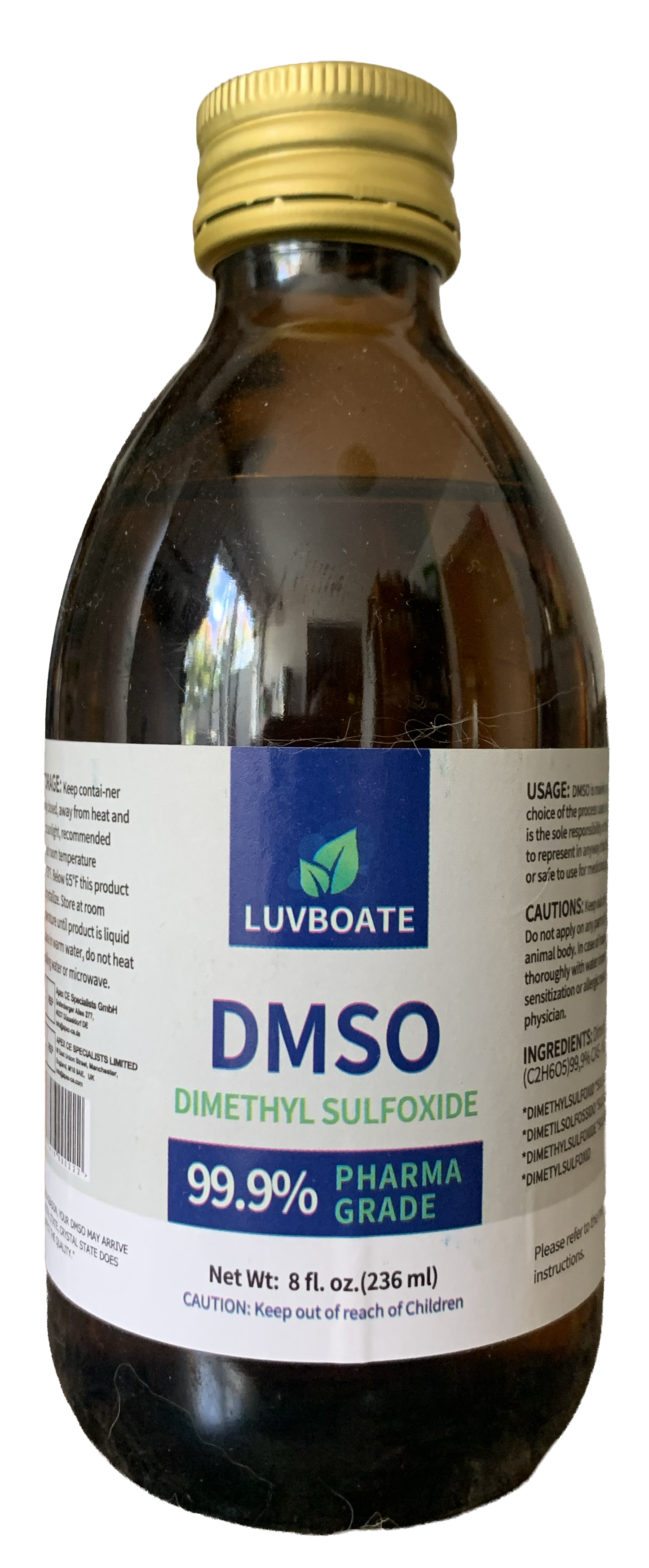
Careful educational overview of DMSO — an industrial solvent famous for soaking through skin and carrying other substances with it. What it is, the one FDA-approved standalone human use (bladder instillation for interstitial cystitis), its role in cell freezing, what pain research actually shows, an early-research box on vitamin C + DMSO for superficial skin cancers, and the longest safety section on the site. Shelf example: Luvboate DMSO 99.9% — a solvent product, not a medicine.
Read this first. This page is chemistry, research and safety literacy. It is not medical advice, not a treatment protocol, and not a claim that DMSO cures, treats or prevents any disease. DMSO is not a vitamin, mineral or supplement. Outside of a few clinician-given or pharmacy-made products, it is sold as a solvent, and solvent bottles generally say they are not for medical use. Because DMSO pulls whatever is on your skin into your body, mistakes with it carry more risk than mistakes with most products on this site. This page deliberately gives no recipes, mixing ratios or dosing. Pregnancy, children, prescription medicines, liver/kidney disease, eye disease, and any diagnosed cancer or neurological condition all need a clinician first.
What DMSO is
Evidence tag: LITERACY. Dimethyl sulfoxide (C2H6OS) is a clear, nearly odourless liquid made as a by-product of the wood-pulp and paper industry. Chemically it is a powerful polar solvent: it mixes with water and with many oils, and it dissolves a wide range of substances that other liquids cannot. It freezes at around 18 °C (65 °F), which is why bottles often warn that it may arrive crystallized in cool weather (PMID 36459193; Swanson review PMID 3916302).
Educational takeaway: DMSO is a chemical tool that medicine borrows for a few specific jobs. It is not a nutrient, and the body has no requirement for it. Most of the excitement around it comes from one property, covered next.
Why it's famous: it carries things through skin
Evidence tag: STRONG. DMSO absorbs rapidly through intact skin and temporarily loosens the skin barrier, so other molecules dissolved in it pass through too. Medicine uses this as a penetration enhancer. The best-known example is an FDA-approved topical diclofenac solution for knee osteoarthritis (sold as Pennsaid), where DMSO is part of the vehicle that helps the anti-inflammatory drug reach the joint (PMID 22030943; knee-OA RCT PMID 15313991).
The flip side: whatever is on your skin goes in
The same property that helps a drug through also helps anything else through: lotion, perfume, dye, soap residue, solvents on your hands, ink, pesticide residue, or contaminants in a low-purity bottle. This is the single most important safety idea on the page. "It carries things in" is the real story, the opposite of the "pulls toxins out" myth.
The one FDA-approved human use: bladder (interstitial cystitis)
Evidence tag: STRONG. The only standalone DMSO drug approved in the US is RIMSO-50, a sterile pharmaceutical solution that a clinician places directly into the bladder through a catheter for symptom relief of interstitial cystitis (painful bladder syndrome). Its label states it "has not been approved as being safe and effective for any other indication" and that it is not for intravenous or intramuscular use (RIMSO-50 label (DailyMed)).
A 2025 meta-analysis of about 554 patients found bladder DMSO lowered symptom and pain scores; adverse events were common (about 38%) but mostly mild, such as temporary bladder irritation (PMID 40205912). A 2026 international consensus still lists DMSO among intravesical options (PMID 40783827), and real-world data from Japan's approval support use in Hunner-type IC (PMID 37817647).
Literacy point: this is a sterile, pharmaceutical-grade product given by a clinician into one organ. It is not evidence for rubbing a solvent bottle on your skin or swallowing it.
Medicine's quiet workhorse: cell and tissue freezing
Evidence tag: STRONG (lab / transplant use). DMSO is a standard cryoprotectant: it stops ice crystals from destroying cells when stem cells, cord blood and some tissues are frozen for storage (PMID 32342730). When frozen stem-cell products are infused, some patients have reactions (nausea, flushing, blood-pressure or heart-rhythm changes); DMSO is one suspected contributor, though causes are often mixed (PMID 29891441; review PMID 40826088, which has industry-affiliated authors).
Takeaway: medicine trusts DMSO to protect cells in a freezer, and it still watches closely for side effects when even small amounts enter the bloodstream.
Mechanism (animal). In cat nerve experiments, DMSO slowed and blocked conduction in C-fibers, the slow nerve fibers that carry dull, burning pain (PMID 8469412). This is the honest basis for the popular line that DMSO "blocks pain nerves." It is a lab finding in animals, not proof of nerve repair in people.
CRPS (complex regional pain syndrome). In a small Dutch RCT (n=32), a compounded DMSO cream beat placebo cream for acute CRPS symptoms (PMID 8721469). In a larger 146-patient RCT it performed about the same as oral N-acetylcysteine overall, and somewhat better for "warm" CRPS (PMID 12670672; see our NAC page). Dutch CRPS guidelines have listed it (PMID 17725255), while a Cochrane overview rates the evidence for CRPS treatments as low quality overall (PMID 37306570).
Joints and muscles (older work). A 1985 review found topical DMSO could give quick but temporary relief, and concluded that claims of anti-inflammatory effects or accelerated healing were "unwarranted" (PMID 3916302).
Page stance
Short-term symptom relief has been studied, mostly in small or old trials, using prepared creams under medical supervision. That is not the same as curing nerve damage, regrowing nerves, or reversing arthritis, and it does not support using undiluted solvent at home.
Skin conditions & vitamin C in DMSO (early research)
Evidence tag: EMERGING. This is the research behind the vitamin C + DMSO posts circulating on X. It is real, but it is smaller, earlier and narrower than the posts suggest.
Emerging research box: vitamin C + DMSO for superficial skin cancers
What was studied. A single research group in Boise tested a topical vitamin C (ascorbic acid) solution made with DMSO as the carrier, applied to biopsy-confirmed, superficial skin cancers under dermatologist supervision.
Basal cell carcinoma (peer-reviewed RCT, 2022). Low-risk BCC; 25 patients / 29 lesions; vitamin C–DMSO cleared 86.7% of lesions vs 57.1% with imiquimod cream at 8 weeks (PMID 35217280). Single center, small, short follow-up.
Squamous cell carcinoma in situ (preprint, 2025). 17 patients / 27 lesions; open-label with no control group; about 56% of lesions cleared on biopsy; leftover lesions were then treated with standard cryotherapy (medRxiv preprint 10.1101/2025.10.13.25337920). This is the study behind the Hulscher post. It is not peer-reviewed, and the trial registration it cites (NCT04279535) appears to be the earlier BCC trial, an unresolved discrepancy.
Caveats that matter. "In situ" means the cancer has not invaded deeper tissue. These results say nothing about melanoma, invasive or spreading cancer, internal cancers, or undiagnosed spots. Headlines like "94% avoided surgery" are accurate only inside that 17-person preprint and should not be read as "you can skip surgery."
Emerging ≠ proven. Not DIY. Any new or changing skin spot needs a proper diagnosis first. If this research interests you, take the published paper to a dermatologist. Do not self-treat. Related: Vitamin C, basal cell skin cancer.
Other skin findings (small, mixed). DMSO has been studied as an add-on to laser treatment for macular amyloidosis (PMID 39400574; dermatology review PMID 36459193). For scleroderma finger ulcers, a randomized trial of 84 patients was negative, and more than a quarter of those on the stronger DMSO solution withdrew because of skin toxicity (PMID 3884019); a systematic review rates the evidence low (PMID 34043013).
Brain swelling, spinal cord & ALS: where the hype comes from
Evidence tag: ANIMAL / HISTORICAL. In the 1970s and 80s, researchers tested DMSO in animal spinal-cord and brain injury models (PMID 7025250), and doctors gave it intravenously in hospital to a handful of severe head-injury patients to lower pressure inside the skull (10 patients in PMID 2290457; PMID 6576703; pharmacology review PMID 19443933). Those protocols were never adopted into standard care.
What does not exist
There are no human randomized trials showing DMSO treats ALS, multiple sclerosis, stroke recovery, chronic spinal-cord injury or other neurological diseases. A PubMed search finds no clinical ALS study, and ClinicalTrials.gov lists no ALS trial of DMSO. Recovery stories shared on social media are anecdotes; they cannot tell us what would have happened anyway, what else was used, or how many people saw no benefit. If you or someone you love has a neurological diagnosis, please keep your specialist involved.
Infection, wounds & "antimicrobial" claims
Evidence tag: ANIMAL / IN VITRO. Research includes burn-wound infection in rats (PMID 6576686) and lab-dish biofilm work with a combined wound agent (PMID 34502378). DMSO is also the standard solvent for dissolving test compounds in antimicrobial lab experiments, which is often misread as "DMSO kills germs." There is no human evidence for treating infections with DMSO, and the RIMSO-50 label specifically notes there is no evidence for its use in urinary tract infections (RIMSO-50 label (DailyMed)).
Garlic breath & other things you'll notice
Evidence tag: STRONG / SAFETY. The body converts some DMSO to dimethyl sulfide, which produces a garlic- or oyster-like taste within minutes and breath and skin odour that can last up to about 72 hours (RIMSO-50 label (DailyMed); PMID 14148434). Skin warmth, redness, itching, dryness and stinging are common, and they get worse as concentration rises (PMID 3916302).
Safety: what the label and studies warn about
Evidence tag: SAFETY (pillar). These points come from the FDA-approved RIMSO-50 label and peer-reviewed toxicology. Read them as the minimum, not the full list.
Eyes: lens changes
Animals given DMSO long-term at high doses developed changes in the eye's lens (refractive and nuclear lens changes), with dogs most affected (PMID 1124535; PMID 1093466). The RIMSO-50 label advises full eye exams, including slit-lamp exams, before and during treatment. Keep DMSO away from the eyes, and talk to a clinician if you have any eye condition.
Carrier effect. Increases absorption of whatever is dissolved in it or sitting on the skin: drugs, dyes, solvents, fragrance and contaminants (PMID 22030943; PMID 36459193). Purity and clean, bare skin matter.
Drug interactions. The label warns DMSO "potentiates other concomitantly administered medications." Older work documents a serious interaction with the anti-inflammatory sulindac (nerve toxicity) and altered sulindac metabolism in rats (PMID 3916302; PMID 6120805).
Lab monitoring. Even under medical supervision, the label advises liver, kidney and blood-count tests about every six months during treatment.
Allergy and histamine. Histamine release and hypersensitivity reactions are reported on the label.
Intravenous use is dangerous. IV DMSO has caused red-blood-cell breakdown (hemolysis) and enzyme changes, and one elderly patient became seriously ill after IV DMSO for arthritis (PMID 6107630; PMID 3916302). The approved product is labelled not for IV or IM use.
Skin toxicity. Rash, itching and blistering scale with concentration; in the scleroderma trial, more than 25% on the stronger solution withdrew for skin toxicity (PMID 3884019).
Not biologically inert. Even a very low concentration (0.1%) changed the activity of more than 2,000 genes and altered microRNA and DNA methylation in human lab-grown microtissues (PMID 30874586, in vitro). We don't know what this means for people, but it argues against treating DMSO as harmless.
Pregnancy and children. DMSO caused birth defects in some animal studies; there are no adequate human studies, and the label says to use it in pregnancy only if clearly needed. Safety in children is not established.
Historical toxicology. Early high-dose human volunteer studies from the 1970s exist (Brobyn, PMID 1055563, abstract not indexed) and are cited here as history, not reassurance.
FDA & legal status literacy
Evidence tag: LITERACY. In the US, DMSO is approved only as RIMSO-50 for interstitial cystitis and as an ingredient inside certain approved products (such as the diclofenac topical solution). Solvent-grade DMSO is legal to sell, but it cannot legally be marketed to treat or cure disease. In 2026 the FDA issued an online advisory letter to a seller marketing DMSO for autism, cancer, COVID-19, dementia, diabetes, HIV/AIDS and seizures, treating it as an unapproved new drug. Some states require non-drug DMSO to carry wording such as "May be unsafe. Not approved for human use" (e.g., Florida).
"Pharma grade" is not a drug approval
Words like "99.9% pure" and "pharma grade" on a solvent bottle describe purity marketing. They do not mean the product is sterile, approved, or tested for use on or in the body. Canadian readers: rules differ by country, so check Health Canada's current status. This section summarizes US FDA labelling only.
Myths & red flags
"DMSO cures 'incurable' nerve, brain or spinal-cord damage." Drop. Animal and decades-old hospital IV data only; no human trials.
ALS recovery stories. Drop. No human data and no registered trial.
"80% of what people see neurologists for goes away." Drop. An unattributed impression, not data.
"Dead muscle grew back / drop foot cured." Drop. Single testimonials.
"600+ studies prove it" / "regenerates nerves." Drop. The count can't be verified, many are lab solvent studies, and nerve regeneration isn't shown in humans.
"Treats migraine, fibromyalgia, trigeminal neuralgia, diabetic, chemo or 'vaccine' neuropathy." Drop. No controlled human evidence found.
Social-media cancer "protocols" that include drinking DMSO alongside other drugs. Drop. Not supported by evidence and risky; DMSO can strengthen the effects of other drugs. Talk to your oncologist.
"DMSO cures cancer." Drop. Only the narrow, early vitamin C topical research on biopsy-confirmed superficial lesions is discussed on this page.
"Antibacterial / antiviral / kills infections." Drop. Animal and lab-dish data only.
"Detox / pulls toxins out." Drop. The real risk is the opposite: it carries things in.
Drinking it or self-injecting. Never. Toxicity and hemolysis risk; the approved product is not for IV/IM use.
"It's natural because it comes from trees." Misleading. It is an industrial solvent made during paper production.
How people use it (principles only, not a recipe)
Evidence tag: LITERACY + SAFETY. People do use DMSO on their own skin, so here are the safety principles reflected in the research and labelling. This site does not publish mixing ratios, strengths, amounts or schedules. If you are considering DMSO, decide with a clinician who knows your medicines.
Bottle strength is not "ready to use." Published skin studies used prepared, diluted products, and skin reactions rise with concentration.
Clean, dry, bare skin. No lotions, perfumes, makeup, sunscreen, tattoo aftercare products or residues underneath, because they will be carried in too.
Clean hands and clean tools. Glass or appropriate containers only, since DMSO can dissolve some plastics and pull those chemicals along.
Purity matters. Low-grade or unknown-source DMSO may contain contaminants that it then carries into the body.
Patch test, and stop if you get blistering, hives, widespread rash or breathing symptoms. Seek care.
Keep it away from eyes, mouth, broken skin and children.
Don't drink it. Don't inject it.
Tell your clinician and pharmacist, because of the drug-interaction warning.
None of this is a dosing order, a disease treatment, or a substitute for medical care.
Who should talk to a clinician first
Pregnancy, trying to conceive, or breastfeeding
Children and teens
Anyone taking prescription medicines, especially blood thinners, heart, seizure, sedative, steroid or anti-inflammatory drugs (DMSO can strengthen drug effects)
Liver or kidney disease
Bladder or urinary-tract cancer (label caution)
History of allergies, hives or asthma
Any eye disease, or anyone who has had eye surgery
Anyone with a diagnosed cancer, neurological disease or spinal injury. DMSO should not replace or delay standard care.
Any new, changing or bleeding skin spot. Get it diagnosed before trying anything on it.
Shelf example
Educational bottle example from the Links photos. This is not a "best brand" verdict, not a sales pitch, and not a suggestion that this bottle is a medicine.
Luvboate
DMSO (Dimethyl Sulfoxide) 99.9%
8 fl oz (236 mL) amber glass bottle with a metal screw cap; labelled "99.9% Pharma Grade"; "Keep out of reach of children." The storage panel notes it may crystallize below about 65 °F and should be warmed gently in warm water, not microwaved.
Solvent product, not a medicine
The usage/cautions panel on this bottle reads as a standard solvent disclaimer: the buyer is responsible for how it is used, and it is not represented as safe for medical use. It also advises rinsing with water on contact and seeing a physician for irritation or allergy. "Pharma grade" is purity marketing, not FDA approval. [Draft note: exact side-panel wording to be confirmed from a clear photo before publishing.]
Watch
No DMSO-titled video was in the playlists used for neighbouring pages. When a careful DMSO education video is supplied, it can embed here. For the vitamin C + DMSO discussion on social media, the primary sources are linked in the early-research box above. Meanwhile browse the playlists on the Videos page.
PubMed links are starting points for self-education. Always read primary papers in full context and consult professionals for personal decisions. Social-media posts that prompted this page are not linked as sources; only the primary studies they refer to are listed.