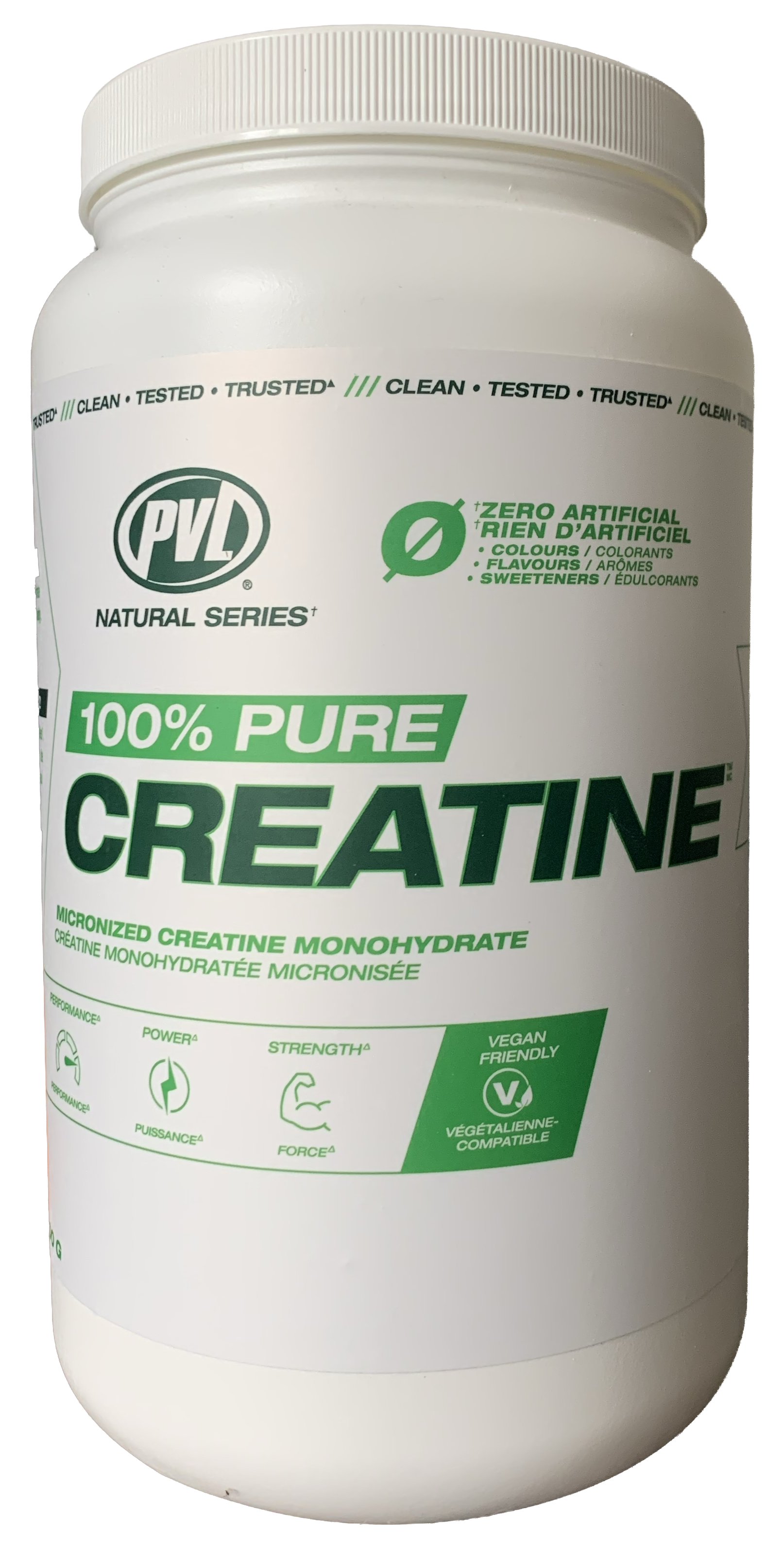
Deep educational overview of creatine and phosphocreatine — the short-burst phosphate buffer that regenerates ATP. Muscle, aging, brain, food vs monohydrate, and safety literacy — not a dosing prescription. Shelf example: PVL Natural Series 100% Pure Creatine (micronized creatine monohydrate).
Read this first. This page is nutritional and sports-nutrition literacy — chemistry, physiology, research summaries, and safety context. It is not medical advice, not a personal loading plan, and not a claim that creatine cures disease. Creatine is not an anabolic steroid. Kidney disease, pregnancy, breastfeeding, rising creatinine of unclear cause, and medication contexts need a clinician before you change intake.
What creatine is
Creatine is a nitrogenous compound the body makes mainly from arginine, glycine, and a methyl group from methionine (via S-adenosylmethionine). It is stored mostly as free creatine and phosphocreatine (PCr). Daily turnover is roughly 1–2 g (as urinary creatinine), replaced by diet plus endogenous synthesis.
Educational takeaway: creatine is an energy-buffer molecule, not a protein powder substitute and not a hormone. Orthomolecular and sports-nutrition teaching both treat it as cellular energy logistics — phosphate transfer so short, intense work can continue for seconds to tens of seconds before glycolytic and oxidative systems dominate.
Endogenous synthesis consumes methyl groups (SAM). People studying methylation maps sometimes note creatine as a methyl sink — educational adjacency to folate, B12, and choline, not a mandate to supplement creatine “for methylation.”
How creatine works — the phosphocreatine / ATP buffer
The creatine kinase reaction quickly donates phosphate from phosphocreatine to ADP to remake ATP during brief, high-demand efforts (sprints, jumps, heavy lifts, repeated bouts). When demand falls, ATP can recharge the phosphocreatine pool. That is the classic “phosphagen” or PCr–ATP energy buffer taught in exercise physiology.
Seconds-scale power — Best matched to short, intense efforts and intermittent sports, not as a primary fuel for long steady-state endurance.
Intracellular water — Raising muscle creatine often pulls water into the cell early on. Educational language: intracellular hydration shift, not pathologic edema — and not the same as lasting “fat gain.”
Training synergy — Reviews repeatedly note that lean-mass and strength signals are strongest when creatine is paired with progressive resistance training, not taken in isolation as a magic powder.
Neighbor nutrients often sit in the same conversation: magnesium (ATP–Mg), protein adequacy via the amino acids hub, sleep, and overall training load.
Where creatine lives in the body
About 95% of body creatine sits in skeletal muscle. Smaller pools exist in the brain, heart, and other high-energy tissues. Brain phosphocreatine is why cognition and metabolic-stress research appears later on this page — as mechanism literacy, not a disease-treatment claim.
Creatine spontaneously and enzymatically converts to creatinine, which the kidneys clear into urine. That dual identity matters for lab literacy: serum creatinine is both a filtration marker and a creatine-metabolism product, so intake changes can confuse interpretation without context.
Food vs supplemental creatine
Muscle meats and fish supply creatine in grams-per-kilogram ranges (herring, beef, pork, and salmon are classic textbook examples). Cooking and drip loss reduce recoverable creatine. Typical mixed diets rarely push muscle stores to the ceiling that supplemental monohydrate can reach in research protocols.
Vegetarians and vegans typically run lower muscle creatine from food alone — a factual nutrition observation, not a judgment. Supplemental creatine monohydrate is used educationally when dietary intake is low or when someone is studying loading/maintenance protocols under professional guidance. This site does not prescribe loading schemes.
Muscle, strength & performance
Evidence tag: STRONG for high-intensity performance, strength, and lean-mass support when creatine monohydrate is combined with resistance training. The International Society of Sports Nutrition (ISSN) position stand summarizes decades of work on efficacy and safety in exercise settings (PMID 28615996). A 2021 misconceptions review answers common athlete questions with the same monohydrate-first framing (PMID 33557850).
A 2022 meta-analysis found creatine increased lean body mass overall, with clearer gains when combined with resistance training (about +1.1 kg vs training alone in that analysis), and a larger average response in males than females across the pooled trials (PMID 35986981). Word carefully: averages are not your personal outcome; training quality, protein, sleep, and starting status still dominate.
Recovery & inflammation markers — being studied (not a pillar claim). Creatine’s best-supported roles remain strength, power, and lean-mass support with training. Research has also asked whether supplementation changes blood markers of inflammation. A 2026 systematic review and meta-analysis of randomized double-blind trials did not find a clear reduction in common markers such as CRP or IL-6 (PMID 41798953). A few small endurance studies reported smaller rises in some cytokines / PGE2 after extreme races following a short loading phase (PMID 17917696) — interesting, still early. Teach creatine for energy buffering and training support; treat “anti-inflammatory supplement” language as under study, not established. Do not import marketing lines like “drops inflammation and shrinks fat.”
Healthy aging & muscle
Evidence tag: STRONG with resistance training. Meta-analyses in older adults find that creatine plus resistance training increases lean tissue mass and upper- and lower-body strength more than training alone (PMID 29138605; PMID 24576864). Narrative reviews extend the conversation to sarcopenia, frailty, and aging musculoskeletal health — always as adjunct literacy beside progressive training, protein, and clinical care (PMID 35688360).
Creatine is not a substitute for lifting, walking, balance work, or medical evaluation of falls risk. Educational framing: training is the stimulus; creatine is a researched nutritional adjunct for some adults studying that protocol with a clinician or qualified coach.
Brain & cognition
Evidence tag: MODERATE / EMERGING. The brain stores phosphocreatine and is metabolically expensive. Creatine supplementation can raise brain creatine in some imaging work, with signals that appear more often under metabolic stress (sleep loss, aging) than in every young, well-rested volunteer.
Memory-focused meta-analyses report small-to-moderate improvements versus placebo, with stronger pooled effects in older adults in one analysis (PMID 35984306). A 2024 cognitive meta-analysis found benefits for memory, attention time, and processing-speed time, with mixed or null results for overall cognition and executive function, and moderate certainty mainly for memory (PMID 39070254). An earlier review suggested short-term memory and reasoning may improve, with conflicting results elsewhere (PMID 29704637).
Acute sleep-deprivation work with a high single dose is mechanistic interest, not a DIY night-shift protocol (PMID 38418482). A 2023 narrative “heads up” review and a 2026 methods-focused brain review urge careful dosing/duration expectations and honest limits of current brain data (PMID 37368234; PMID 41556609).
Educational label — not a dementia treatment
Brain-creatine literacy is not a claim that creatine treats Alzheimer’s disease, concussion, or any neurologic diagnosis. Those research threads are preliminary and belong with clinical teams.
Mood — careful emerging note
Evidence tag: EMERGING. Some brain-health reviews mention mood, depression, and anxiety as research interests alongside cognition (PMID 37368234). That is not the same as teaching creatine as an antidepressant or anxiolytic. Hold the door open for future trials; do not replace prescribed mental-health care with a powder.
Bone health
Evidence tag: MIXED — no clear BMD effect in pooled work. A brief meta-analysis found no greater effect of creatine plus resistance training versus training alone on whole-body, hip, femoral-neck, or lumbar-spine bone mineral density in older adults (PMID 29740583). A 2-year postmenopausal RCT similarly found no BMD advantage, though some femoral-neck geometric indices and walking time improved alongside lean tissue in completers (PMID 37144634).
Educational honesty: do not market creatine as an osteoporosis drug. Bone conversations still center on training stimulus, protein, vitamin D / K / magnesium literacy, and clinical densitometry when indicated — see Vitamin D and Magnesium.
Blood sugar & metabolic health
Evidence tag: EMERGING / mixed for broad claims. One randomized trial in type 2 diabetes found creatine plus an exercise program improved HbA1c and meal-test glycemia versus placebo plus exercise, with a GLUT-4 translocation signal (PMID 20881878). A later systematic review and meta-analysis, however, concluded there was an insufficient basis to state that creatine reliably improves fasting glucose or insulin resistance across available human studies (PMID 35063192).
Teach as research interest under clinician-supervised diabetes care — never as a reason to stop medications or ignore glucose monitoring.
Women across the lifespan
Evidence tag: MODERATE / EMERGING. Women were under-represented in early creatine trials; newer reviews discuss menstrual-cycle context, pregnancy research questions, and menopause-era training support (PMID 40371844). Lean-mass meta-analyses suggest average responses can differ by sex when training is held constant (PMID 35986981) — averages, not destiny.
Pregnancy and lactation: clinician first. Do not self-experiment from internet loading charts.
Vegetarians & vegans
Evidence tag: MODERATE. Because creatine is concentrated in animal muscle, vegetarian and vegan diets usually deliver less preformed creatine. Supplemental monohydrate raises muscle creatine stores (often to or above omnivore levels in trials) and has improved strength, lean tissue, and some cognitive measures in vegetarian participants in reviewed studies (PMID 32349356; memory signal in young vegetarian women after short loading — PMID 21118604).
Shelf note: many creatine monohydrate powders (including the PVL example below) are labeled vegan-friendly because the molecule is synthesized, not extracted from meat — still verify each brand’s testing and labeling.
Forms: why monohydrate is the reference
Creatine monohydrate is the form used in the large majority of clinical and sports-nutrition trials — including every study in several cognitive meta-analyses. Marketing variants (HCl, buffered, ethyl ester, nitrated blends, etc.) mainly compete on solubility, taste, or GI anecdotes. Textbooks and ISSN-linked reviews still treat monohydrate as the evidence anchor (PMID 33557850; PMID 28615996).
Micronized monohydrate — smaller particle size for mixability; same core molecule. Shelf example: PVL Natural Series 100% Pure Creatine.
“Buffered” / alternative salts — not shown superior to monohydrate for outcomes that matter in meta-analyses; price and marketing differ.
Stability — dry monohydrate is stable; liquid products need careful formulation literacy.
How creatine is typically used (research literacy — not a prescription)
Published protocols often use approximately 3–5 g/day of creatine monohydrate as a maintenance intake, or about 0.1 g/kg/day in some papers. A short “loading” phase (historically ~20 g/day split into several doses for 5–7 days) saturates muscle faster; the same total can be reached more slowly with daily lower intakes without loading. Loading is optional in modern educational summaries (PMID 33557850).
Not a dosing order
Figures above describe what researchers commonly study. They are not personalized medical advice. Large single boluses can upset the gut; splitting doses and taking with food or carbohydrate-containing meals is common practical coaching — still subordinate to clinician guidance if you have kidney, GI, or medication concerns.
Safety, myths & who should talk to a clinician first
ISSN and related reviews describe creatine monohydrate as relatively well tolerated at researched intakes in healthy people, with a long safety literature in exercise contexts (PMID 28615996; PMID 33557850). A renal-function meta-analysis did not find evidence that typical supplemental amounts induced kidney damage in the studied populations and durations (PMID 31375416) — that is not permission to ignore known kidney disease.
Myth: “creatine is a steroid.” False. Different chemistry and legal class entirely.
Myth: “creatine wrecks healthy kidneys.” Not supported in healthy cohorts at researched doses; known CKD or rising creatinine of unclear cause → clinician first. Serum creatinine can rise modestly with creatine use without equating to filtration failure.
Myth: “creatine causes hair loss.” A 12-week RCT found no group differences in DHT or hair-follicle measures versus placebo (PMID 40265319).
Myth: “creatine causes dehydration and cramps.” Not supported as a general rule in the misconceptions review; hydrate with training as usual.
Water weight — Early scale bumps often reflect intracellular water, not sudden fat mass.
GI upset — More common with large single doses; reduce bolus size.
Optional embed from the Creatine / Vitamin D / Inflammation source playlist Patrice shared. Education on this page follows PubMed-linked reviews — not YouTube titles. A second playlist video with marketing language about “dropping inflammation” is not embedded here so hype claims do not drive the copy.
More playlists live on the Videos page. Pair any video with the inflammation literacy note under Muscle / Performance above.
PubMed links are starting points for self-education. Always read primary papers in full context and consult professionals for personal decisions. Most clinical funding streams prioritize pharmaceutical products; nutritional and sports-nutrition literature still documents creatine extensively — offered here solely for learning.